Is Baptism Required?
Common misconceptions and manipulations of the Bible exist. It is a shame, especially within the church, that there is always such division over secondary issues. Questions like “Is Jesus God the Father and God the Son?” or “Once saved, always saved?” often produce answers that are both true and untrue depending on how they are framed and carefully understood from the whole of Scripture.
Is Jesus God or the Son of God? Yes, He is both (John 1:1, 14; John 10:30; Colossians 2:9), and entire churches have separated over this topic. Is it true that you are once saved, always saved, or can you lose your salvation? Yes. The answer is both in this sense: once you give your life to Christ and become part of His bride, nothing outside of you can separate you from Him—no sin, no death, no power, no man (Romans 8:38-39; John 10:28-29). Only your own later, willful rejection of Christ can blot your name out of the book of life (Revelation 3:5). Entire movements have been built on that tension.
Is baptism required for salvation, or can you be saved without it? Once again, entire churches and denominations have been built and divided over this single issue. I believe we should eventually do a full series on these topics so we can examine what the Bible actually says and how we should respond when someone presents something other than the pure gospel.

Today we turn our attention to baptism, because it has become a topic where many elevate an outward act of devotion above the living faith that moves mountains (Matthew 17:20; Mark 11:23). The heart of the gospel has always been simple trust in God’s promise, not the completion of any ritual.
In the Old Testament, did you have to slaughter animals to be saved? No. That idea is a complete misunderstanding. The message of Scripture has always been the same from beginning to end. Salvation was by faith in the God of Abraham, Isaac, and Jacob (Genesis 15:6; Habakkuk 2:4; Romans 4:3). The Israelites were God’s covenant people. Males were circumcised as a sign of that covenant and then lived under the law. Those outside the covenant nation (Gentiles) were not automatically considered children of God.
When a Gentile wanted to join the people of God, there were clear steps. First came genuine belief and faith in the God of Abraham, Isaac, and Jacob. Second, circumcision for the males served as a mark of commitment and submission, even though it was uncomfortable and painful. It showed a willingness to put the flesh in its place and suffer for obedience to God, similar in spirit to fasting. The cutting of the foreskin marked the organ of generation because the covenant promise centered on offspring and seed (Genesis 17:10-14).
Yet Scripture records plenty of people who were never circumcised and were still accepted by God and used by Him. Melchizedek appears in Genesis 14 as a priest of God Most High with no record of circumcision. Job and his friends lived outside of Israel with no mention of the rite. Naaman the Syrian was healed and openly confessed that there is no God in all the earth except the God of Israel while remaining uncircumcised (2 Kings 5:15). The entire city of Nineveh repented at the preaching of Jonah and was spared without becoming circumcised Israelites (Jonah 3:5-10). Ruth the Moabitess, a woman and therefore never circumcised, was fully received into the people of God by faith and commitment and even became part of the lineage of the Messiah (Ruth 1:16-17; Matthew 1:5).
When people sinned and fell short, God required animal sacrifices. He did this because He views sin as foul, harsh, disgusting, and utterly serious (Habakkuk 1:13; Psalm 5:4-5; Proverbs 6:16-19). The slaughter of the animal, the blood on the altar, and the smell of burning flesh and fat were meant to confront the worshiper with the true cost and horror of their rebellion. Those sacrifices never removed sin permanently. They exposed it, produced repentance, and pointed forward to the need for a perfect substitute. Hebrews 10:1-4 states plainly that the law was only a shadow and that it is impossible for the blood of bulls and goats to take away sins.
The entire Torah can be summarized in two great commands: love the Lord your God with all your heart, soul, and mind, and love your neighbor as yourself. Jesus confirmed this in Matthew 22:37-40, declaring these the greatest commandments on which all the Law and the Prophets hang. This reveals that God’s deepest desire has never been the mere outward performance of rituals, but a transformed heart that genuinely loves Him and others.
Repentance is at the center of this transformation. The biblical word for repentance (in the New Testament, the Greek metanoia) literally means “a change of mind.” It is not simply feeling sorry or performing a religious act. It is a decisive turning—a complete shift in how a person thinks, values, and directs their life—away from self and sin and toward God in trusting faith. This change of mind produces a change of heart and direction. That has been the consistent plan from the beginning (Ezekiel 18:30-32; Isaiah 55:7).
Jesus repeatedly confronted the Pharisees on this exact issue. They were the ultimate performers of outward religion. They were meticulous Torah observers, committed to acting like children of God in every visible way. Yet Jesus warned them that they were still not right with God. He told them it is not what you do on the outside that matters most, but the cleansing of the inside. He called them whitewashed tombs—beautiful on the outside but full of dead men’s bones within (Matthew 23:25-28; Luke 11:39-40). Perfect external performance left them lost because their hearts remained unchanged (Mark 7:6-8, 14-23).
Abraham himself was justified by faith in Genesis 15:6, years before God ever commanded circumcision in Genesis 17. The apostle Paul makes a major theological point of this timeline in Romans 4:9-12, showing that righteousness was credited to Abraham while he was still uncircumcised. Circumcision was the outward sign of the covenant, not the means by which a person became right with God. Some pointed to Genesis 17:14 and Exodus 12:48 as requiring the rite for belonging, yet Paul shows those verses concerned covenant membership in national Israel, not justification before God. Baptism functions in the same way under the New Covenant.
The New Testament, which means the New Covenant, is unambiguous about how a person is saved. Ephesians 2:8-9 states, “For by grace you have been saved through faith. And this is not your own doing; it is the gift of God, not a result of works, so that no one may boast.” Romans 10:9-10 declares, “If you confess with your mouth that Jesus is Lord and believe in your heart that God raised him from the dead, you will be saved. For with the heart one believes and is justified, and with the mouth one confesses and is saved.” Acts 16:31 says simply, “Believe in the Lord Jesus, and you will be saved.” John 3:16, 18, and 36 all promise eternal life and freedom from condemnation to whoever believes. Galatians 2:16 adds that a person is not justified by works of the law but through faith in Jesus Christ. Paul goes so far as to say in 1 Corinthians 1:17 that Christ did not send him to baptize but to preach the gospel.
Paul defines that gospel with precision in 1 Corinthians 15:1-4. He reminds the church of the message he preached: that Christ died for our sins in accordance with the Scriptures, that He was buried, and that He was raised on the third day in accordance with the Scriptures. Notice what is completely absent. There is no mention of baptism as a requirement. That is the gospel. Anything added to it is a different message (Galatians 1:6-9).
Jesus said, “I am in the Father and the Father is in me” (John 14:10-11). To believe in Jesus is to believe in the Father. The one who believes on the Son is saved (John 3:36; John 5:24; John 6:40, 47). God is not waiting for a human performance to complete what His Son already finished on the cross (John 19:30).
When a person accepts Jesus Christ—when they believe in their heart and confess Him as Lord—salvation occurs at that very moment. The Holy Spirit immediately seals the believer (Ephesians 1:13-14; 4:30; Romans 8:9, 16). He regenerates the heart (Titus 3:5), makes the person a new creation (2 Corinthians 5:17), indwells them permanently, convicts of sin (John 16:8), teaches truth (John 14:26), brings comfort, empowers for obedience, produces the fruit of the Spirit (Galatians 5:22-23), and serves as the guarantee of the future inheritance. There is no delay until water is applied.
At the same moment of faith, God declares the believer righteous. This is called imputed righteousness. The perfect righteousness of Jesus Christ is credited to the account of the one who believes (Romans 3:21-22; 4:5; 5:17; 2 Corinthians 5:21; Philippians 3:9). Justification is a legal declaration based solely on the finished work of Christ received by faith. It is not progressive, and it is not dependent on any subsequent ritual.
Would a man on his deathbed who sincerely trusts Jesus Christ but dies before he can be baptized go to hell? The very suggestion misunderstands the heart of God’s grace. He commands us to preach the gospel to all creation because the message itself is the power of God for salvation (Romans 1:16; Mark 16:15). You cannot earn it. You cannot complete it. You can only receive it as a free gift (Romans 6:23).
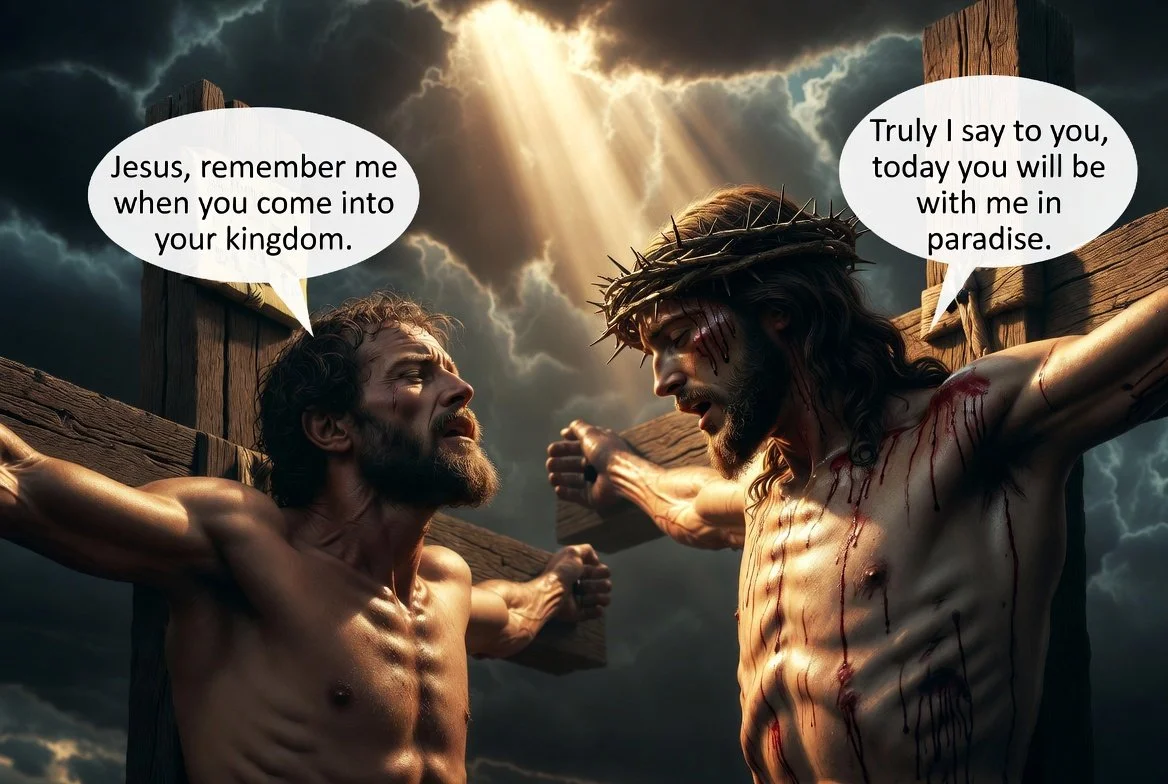
Jesus demonstrated how simple this is when He spoke to the thief on the cross. The dying man simply said, “Jesus, remember me when you come into your kingdom.” Jesus answered, “Truly, I say to you, today you will be with me in paradise” (Luke 23:42-43). There was no baptism, no opportunity for works, no religious process, no time to go through all his sin. Just faith. Jesus was literally showing the entire world how easy and straightforward acceptance of Him is. That is what He wanted us to see. We do not need to overcomplicate what He made clear.
Baptism is a beautiful and important act of obedience. It is a public declaration that visibly portrays the death, burial, and resurrection of Jesus Christ (Romans 6:3-4; Colossians 2:12). The believer goes under the water as a picture of dying with Christ and comes up as a picture of rising with Him to new life. It is done before the watching world and before God as a testimony of the faith that already exists (Acts 8:36-38; 10:47-48).
To claim that God requires this act for a person to be saved turns a joyful declaration of what Jesus has already done into a human work that supposedly finishes the cross. True saving faith will produce obedience, including baptism whenever it is possible (Matthew 28:19-20). True faith will also produce love for God and love for people, and that love will result in good works (Ephesians 2:10; John 14:15).
Faith without works is dead according to James 2:17-26, but that statement refers to the evidence of genuine faith, not the means of obtaining it. A person with consistently poor fruit is revealing a lack of real love for God and people. The root remains faith alone; the fruit follows as the natural result of a changed heart.
The verses commonly used to support the idea that baptism is required for salvation do not teach that doctrine when they are read carefully in context. Mark 16:16 pairs belief and baptism in the normal order of discipleship, yet it ties condemnation only to unbelief. You can have faith without baptism and be saved; you cannot have baptism without faith and be saved.
Acts 2:38 calls for repentance and baptism in connection with the forgiveness that comes through faith. The Greek preposition can indicate the basis or the result, and the rest of Acts consistently links forgiveness to faith and repentance (Acts 3:19; 10:43; 13:38-39). Acts 22:16 links the washing of sins to calling on the name of the Lord, which is an act of faith (Romans 10:13).
First Peter 3:21 explicitly states that the saving element is not the removal of dirt from the body but the appeal of a good conscience to God through the resurrection of Jesus. John 3:5, spoken to Nicodemus, refers to spiritual birth by the Spirit, consistent with the cleansing language of Ezekiel 36:25-27. Galatians 3:27, Romans 6:3-4, and Titus 3:5 describe the rich symbolism of baptism and the work of the Spirit; they do not turn the water into the instrument of justification.
Baptism is commanded by the Lord (Matthew 28:19). It is a powerful public witness. Every believer who has the opportunity should be baptized as an early and joyful step of obedience. But baptism does not save. Faith in the finished work of Jesus Christ saves. The Holy Spirit seals the believer the moment that faith is exercised. The righteousness of Christ is imputed at that same moment. The gospel Paul preached in 1 Corinthians 15 contains no baptismal requirement. The thief on the cross proves how simple Jesus made the way of salvation. The Pharisees prove that perfect outward performance still leaves a person lost if the heart is not changed. The entire sweep of Scripture from Abraham to the apostles declares the same truth. Let us not add human performance to the free gift of God. Let us preach the pure gospel, trust its power, and elevate baptism as the beautiful act of obedience it was always meant to be.