“Go Up, You Baldhead”: Understanding Elisha and the Judgment of the Bears
You might remember Elijah from the Bible.
He stands out as one of the most dramatic figures in the Old Testament, a prophet whose life was marked by unshakable faith and public confrontation with idolatry. In the famous showdown on Mount Carmel, Elijah challenged the prophets of Baal in front of all Israel. He rebuilt the Lord’s altar, soaked the sacrifice with water, and then prayed. Fire fell from heaven and consumed the offering, the wood, the stones, and even the water in the trench (1 Kings 18:20–40). While the prophets of Baal cried out from morning until noon with no answer, Elijah mocked their silent god: “Cry aloud, for he is a god. Either he is musing, or he has gone aside, or he is on a journey, or perhaps he is asleep and must be awakened” (1 Kings 18:27).
Years earlier, Elijah had already shut the heavens so that no rain fell for three and a half years as judgment on Israel’s apostasy (1 Kings 17:1; James 5:17). Later he called fire from heaven a second time to consume soldiers sent to arrest him (2 Kings 1:9–12). These acts permanently marked him as the prophet who dismantled the public worship of false gods. Yet Elijah is frequently confused with Elisha. They are not the same person. Elisha is not Elijah, and Elijah is not Elisha. Even their names reveal the difference. Elijah is pronounced ih-LIE-juh in English (or eh-lee-YAH-hoo in Hebrew). His name means “My God is Yahweh” or “Yahweh is God.”
Elisha is pronounced ih-LIE-shuh in English (or eh-lee-SHAH in Hebrew). His name means “God is salvation” or “My God is salvation.” Both names begin with “El,” the Hebrew word for God, but the rest of each name points in a distinct direction. Elijah’s name declares the identity of the true God against the false gods of Baal—perfectly matching his confrontational ministry. Elisha’s name emphasizes salvation and deliverance—perfectly matching his long ministry of healing, provision, and restoration.
Their callings were also different. Elijah appears suddenly from Tishbe in Gilead, a solitary figure who steps onto the stage of history with a word of drought and judgment (1 Kings 17:1). Elisha, by contrast, was found while quietly plowing a field. He was the son of Shaphat, a prosperous landowner from Abel-meholah in the Jordan Valley. When Elijah first found him, Elisha was driving the twelfth pair of oxen among twelve yoke—clear evidence of significant wealth and status (1 Kings 19:19). The moment Elijah’s mantle fell across his shoulders, Elisha slaughtered the oxen, burned the wooden plow for fuel, cooked the meat, and fed the people around him. He left everything behind—family, farm, and future—to become Elijah’s attendant.
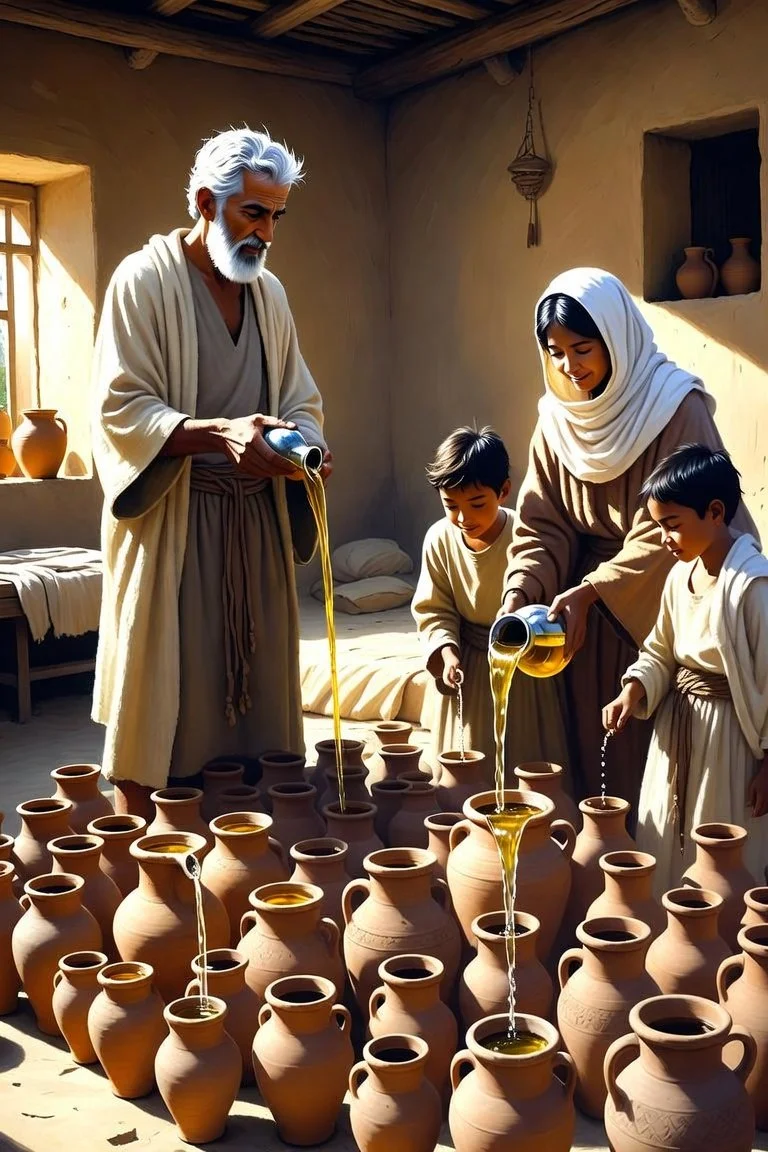
For years he served quietly in the shadow of the greater prophet, learning faithfulness and courage. Once the mantle passed, Elisha’s own ministry stretched across roughly sixty years and four kings. Scripture records him purifying poisoned water, multiplying a widow’s oil, raising a dead child, feeding a hundred men with scant bread, healing a foreign commander’s leprosy, making an iron axe-head float, and repeatedly advising kings. He was known as “the man of God,” a prophet of both tender compassion and unflinching authority.
It is this Elisha—not Elijah—who is involved in the incident with the bears. Freshly confirmed in his office, he had just taken up the fallen mantle, struck the Jordan so that the waters parted before him just as they had for Elijah (2 Kings 2:13–14), and purified the bitter spring at Jericho so that the water became wholesome forever (2 Kings 2:19–22). These signs publicly authenticated him as Elijah’s true successor and as a spokesman of Yahweh.
While he was still traveling from that miracle toward Bethel—an infamous center of golden-calf idolatry established by Jeroboam—a large gang of youths came out of the city and began to jeer at him: “Go up, you baldhead! Go up, you baldhead!” (2 Kings 2:23). The Hebrew terms used—neʿārîm qetannîm and later yelādîm—do not describe toddlers or little children. They refer to youths or young men, a range that elsewhere includes Joseph at seventeen, Isaac in his twenties, Solomon around age twenty, and even military men (Genesis 37:2; 1 Kings 3:7; 1 Kings 20:14–15). The group was large enough that forty-two were mauled, pointing to a sizable mob of accountable adolescents or young adults, not innocent preschoolers.
They came out of the city deliberately to confront the prophet. “Go up” deliberately echoed the same verb used for Elijah’s recent ascent into heaven (2 Kings 2:11). The youths were sarcastically challenging Elisha to disappear the same way if he truly carried prophetic authority. “Baldhead” was a term of deep contempt. It may have implied weakness, uncleanness, or—most significantly—a denial that Elisha legitimately wore Elijah’s mantle.

Coming from Bethel, a stronghold of idolatry, the mockery was an open rejection of Yahweh’s newly confirmed messenger and therefore of Yahweh Himself. Scripture repeatedly warns against such treatment of God’s servants. The Lord Himself declares, “Do not touch my anointed ones; do my prophets no harm” (Psalm 105:15; 1 Chronicles 16:22). Another clear example appears earlier with Elijah. When King Ahaziah sent successive captains of fifty with their men to seize the prophet, they approached with arrogant commands rather than reverence. Elijah called down fire from heaven, and the first two companies were consumed (2 Kings 1:9–12). The pattern is consistent—contempt for the Lord’s prophet is treated as contempt for the Lord, and judgment follows.
In a covenant context, wild animals were even listed among the curses for rebellion (Leviticus 26:22). Elisha’s curse was not personal rage but a judicial act in Yahweh’s name. Two she-bears then came out of the woods and mauled forty-two of the youths (2 Kings 2:24). The text specifically calls them she-bears—female bears—for both linguistic and theological reasons. In Hebrew, the verbs describing their actions are feminine, and female bears were known in the ancient world as the most ferocious of the species, especially when protecting or robbed of their cubs. This detail is no accident. Scripture elsewhere uses the image of a mother bear robbed of her cubs to describe the most intense form of danger or divine wrath. Proverbs 17:12 warns that meeting such a bear is better than dealing with a fool, and 2 Samuel 17:8 compares fierce warriors to a bear robbed of her cubs in the field.
Through the prophet Hosea, God Himself adopts the same image. Speaking to the northern kingdom of Israel, the Lord declares, “I will meet them like a bear robbed of her cubs; I will tear open their breast, and there I will devour them like a lion” (Hosea 13:8). What was God talking about that would provoke such fury? In Hosea 13, He is addressing a people who had known His salvation from Egypt, received His care in the wilderness, and then, once they were filled and prosperous, forgot Him and turned to idols (Hosea 13:4–6). Their persistent covenant-breaking and idolatry stirred the Lord’s protective jealousy for His own honor and for the people who belonged to Him. Turning your back on God is compared to taking a mother bear’s cubs because of the intensity of the relationship and the protectiveness involved.
In the Bible, God repeatedly describes Israel as His own children, the people He delivered from Egypt, fed in the wilderness, and claimed as His special possession (Hosea 11:1; 13:4–5). When they prospered and then forgot Him, chasing after idols instead, it was not a mild disagreement. It was a betrayal of the deepest kind—abandoning the One who had given them life, protection, and identity. A mother bear’s cubs are everything to her. They are her offspring, her responsibility, and the object of her fierce, instinctive care. Anyone who steals or threatens those cubs triggers an overwhelming, deadly response.
In the same way, God portrays His people as belonging to Him in a parental and covenantal sense. When they turn away and give their loyalty to false gods, it is as if something precious that is rightfully His has been seized or destroyed. That provocation stirs His holy jealousy and protective wrath. The she-bears of Bethel are therefore consistent with this wider biblical portrayal. They served as an immediate, visible enactment of the covenant curse already written in the Law: “I will let loose the wild beasts against you, which shall bereave you of your children” (Leviticus 26:22).
Why did the bears have to happen? This was no isolated outburst of temper. It occurred at the precise moment when the prophetic succession needed public confirmation. Had the mockery gone unanswered, Elisha’s authority—and by extension the authority of the God who had just taken Elijah and given Elisha a double portion of his spirit (2 Kings 2:9)—would have been undermined in the very heart of Israel’s idolatry. The judgment was measured, public, and protective of the prophetic office at a critical transition. Just as the people later “kept mocking the messengers of God, despising his words and scoffing at his prophets, until the wrath of the Lord rose against his people, until there was no remedy” (2 Chronicles 36:16), so here the immediate consequence served as a stark reminder that the fear of the Lord is the beginning of wisdom—and that His messengers are not to be treated with scorn.
God Himself is indeed the ultimate “Momma bear.”