If every Bible in the world disappeared tomorrow, what could historians still establish about Jesus Christ? Would there be enough evidence to demonstrate that He existed, was crucified under Roman authority, and inspired a movement whose followers believed He had risen from the dead?
Surprisingly, the investigation would not end with the disappearance of Scripture. Roman historians, Jewish writings, and early Christian testimony provide a historical foundation that cannot simply be dismissed as religious mythology.
Yet Christianity makes a much greater claim than the existence of Jesus. The apostle Paul declared in 1 Corinthians 15:14 that if Christ had not been raised, Christian preaching and faith would be in vain. Christianity therefore places its central claim directly in history. Either Jesus rose from the dead or He did not.
So what does the evidence actually reveal?
1. The Roman Historian Who Confirmed Jesus' Execution
Around AD 116, the Roman historian Tacitus wrote about Emperor Nero's persecution of Christians following the Great Fire of Rome in AD 64.
In Annals 15.44, Tacitus identifies Christus as the origin of the movement and reports that He suffered the extreme penalty under Pontius Pilate during the reign of Emperor Tiberius.
This is remarkable because Tacitus was not a Christian. His account speaks contemptuously of Christianity rather than attempting to promote it.
His testimony independently supports several important historical facts: Jesus was associated with the origins of Christianity, He was executed under Roman authority, and His followers continued spreading their beliefs after His death, eventually reaching Rome.
An objection sometimes raised is that Tacitus wrote decades after Jesus' crucifixion. That is correct, but ancient historical writing frequently described events occurring generations earlier. The age of a document must be considered alongside its sources, purpose, and historical context.
Tacitus does not prove the resurrection, but he provides valuable non-Christian evidence for the execution upon which the Gospel accounts are centered.
2. Josephus: A Jewish Historian Mentions Jesus and His Brother
Another important witness is Flavius Josephus, who wrote Antiquities of the Jews around AD 93–94.
In Book 20, Josephus describes the execution of James, identifying him as the brother of Jesus, who was called Christ. This passage is especially significant because it identifies a member of Jesus' family and connects him to the early Christian movement.
The New Testament also identifies James as Jesus' brother (Galatians 1:19). Josephus independently records his existence and death.
Some critics question whether Christian scribes altered Josephus' writings. That concern is particularly relevant to a different, longer passage about Jesus in Book 18, which contains wording many scholars consider later Christian additions.
However, the shorter reference to James in Book 20 is much more widely accepted as authentic. Its restrained description of Jesus as someone called Christ, rather than an affirmation that He was the Messiah, is one reason it fits Josephus' non-Christian perspective.
This distinction matters. We do not need to defend every disputed sentence attributed to Josephus to recognize that his reference to James provides meaningful corroboration of early Christian history.
3. The Crucifixion: Rome Was in the Business of Execution
The Gospels unanimously report that Jesus was scourged and crucified under Roman authority.
Crucifixion was designed to humiliate, torture, and ultimately kill its victims. Roman soldiers were familiar with the practice, and a condemned person's survival was not the intended outcome.
Physical evidence of crucifixion has also been discovered. In 1968, archaeologists excavating a first-century Jewish tomb near Jerusalem uncovered the remains of a man commonly identified as Yehohanan. An iron nail remained embedded in his heel bone, providing direct archaeological evidence of crucifixion in Roman Judaea.

The pierced heel bone of a first-century crucifixion victim, discovered near Jerusalem. This is evidence of Roman execution practices, not the remains of Jesus.
The theory that Jesus merely fainted on the cross and later recovered fails to adequately account for the circumstances described in the sources. The Gospel of John reports that a soldier pierced Jesus' side (John 19:34), and Tacitus independently confirms that Jesus was executed.
The precise physiological cause of death cannot be reconstructed with certainty. Nevertheless, the combined historical testimony makes Jesus' death by crucifixion one of the most firmly established facts about His life.
The resurrection argument, therefore, does not reasonably begin with the assumption that Jesus simply survived His execution.
4. The Resurrection Testimony Appeared Remarkably Early
One of the most powerful arguments for the resurrection comes from 1 Corinthians 15:3–8.
Writing around AD 53–55, Paul reminds the Corinthian church of testimony he had already received and passed on: Christ died for sins, was buried, rose on the third day, and appeared to Cephas, the Twelve, more than 500 believers, James, and finally Paul himself.
The importance of this passage extends beyond Paul's authorship. Its wording indicates that Paul was transmitting an established tradition rather than inventing a new teaching.
Scholars widely recognize an early traditional core in 1 Corinthians 15:3–5, although they disagree about precisely how much of verses 6–7 also belonged to that original formulation. Some scholars date the tradition to within a few years of the crucifixion.
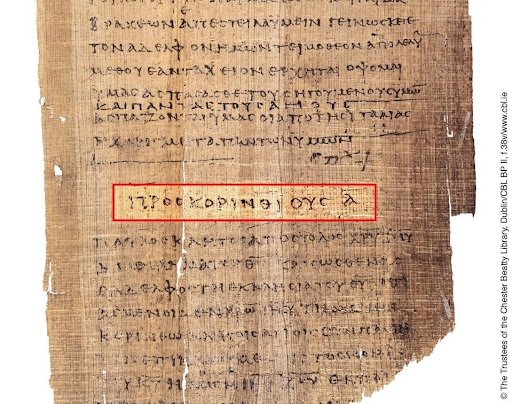
Papyrus 46 is an early surviving collection of Paul's letters, generally dated around AD 200. It is not the original letter, but it preserves early manuscript evidence of Paul's writings.
This creates a serious problem for the idea that belief in the resurrection developed as a legend centuries after Jesus.
Whether someone accepts the resurrection as historical or not, the belief itself was present among Jesus' earliest followers. The central message of Christianity was not gradually invented by medieval religious authorities. It was being proclaimed in the first generation of the Christian movement.
Paul's statement concerning the 500 witnesses is also noteworthy. He reports that many were still alive when he wrote, although we do not possess 500 separate surviving testimonies.
Paul names Peter and James individually, and Galatians 1:18–19 records his personal contact with both men. His account was therefore connected to identifiable leaders of the earliest Jerusalem church.
5. The Witnesses Who Had Every Reason to Walk Away
Consider the men who proclaimed that Jesus had risen.
Peter had denied knowing Jesus during His arrest. Paul had persecuted Christians before becoming one of Christianity's most influential missionaries. James, Jesus' brother, is portrayed in John 7:5 as initially unbelieving, yet later became a prominent leader in the Jerusalem church.
Paul's own letters provide firsthand testimony to his dramatic change of allegiance, including his earlier persecution of the church (Galatians 1:13–23). Josephus also records the death of James around AD 62.
Within the New Testament, these men were not presented as individuals who always found Christianity easy to believe. They encountered opposition, danger, and hardship because of their convictions.
A common skeptical response is that people throughout history have willingly died for false religious beliefs. That is true. Sincerity alone does not establish truth.
But there is an important distinction between dying for a belief inherited from others and knowingly inventing an event one claims to have witnessed.
If the apostles deliberately fabricated the resurrection, their willingness to endure suffering becomes difficult to explain. This argument does not establish the exact circumstances of every apostle's death; those traditions vary in historical reliability. It does, however, make the theory of a conscious conspiracy less persuasive.
6. Could the Resurrection Have Been a Hallucination?
Some critics propose that grieving disciples experienced visions of Jesus and interpreted them as evidence of resurrection.
Bereavement experiences are real, and historians must take such explanations seriously. But the Christian accounts describe more than one isolated experience. They include appearances to individuals and groups, encounters involving conversation and physical interaction, and the transformation of people such as Paul.
A purely psychological explanation must therefore address not only Peter's grief but also the wider variety of reported appearances and Paul's unexpected conversion.
Still, it would be inaccurate to claim that hallucinations are scientifically impossible in groups or that every reported appearance has been independently verified. Scholars disagree about what experiences lie behind the resurrection testimony.
The Christian argument is that the bodily resurrection provides a coherent explanation for the earliest testimony, the reported empty tomb, and the rise of the resurrection-centered movement.
Alternatives may account for individual elements, but their advocates must explain the historical evidence as a whole.
7. Even Rome Recognized That Christians Worshipped Jesus
Around AD 112, the Roman governor Pliny the Younger wrote to Emperor Trajan seeking advice about prosecuting Christians.
He reported that Christians met on a fixed day and sang hymns to Christ as to a god. Some refused to renounce their faith even under threat of execution.
This is particularly significant because Pliny was investigating Christianity as a perceived problem for Roman authority. He had no reason to exaggerate its religious significance in favor of Christians.
His testimony confirms that devotion to Christ as divine was established long before the Council of Nicaea in AD 325.
Although this does not independently prove Jesus' divinity, it contradicts the claim that worship of Jesus was first invented by that fourth-century council.
The Verdict: What Best Explains the Evidence?
The historical case for Jesus rests on more than a collection of religious stories. Roman sources confirm His execution and the existence of His followers. Jewish historical writings identify His brother James. Paul's letters establish that resurrection testimony circulated within the earliest Christian generation. Even hostile Roman officials documented the remarkable devotion Christians showed toward Jesus.
These historical facts deserve a serious explanation.
The strongest objection is that sincere religious experiences do not necessarily demonstrate a supernatural event. That is a legitimate distinction. But rejecting the possibility of resurrection before examining the evidence is not a historical argument either; it is a philosophical assumption about what can happen.
The Christian case is that Jesus truly died, that His earliest followers sincerely believed they encountered Him alive afterward, and that His bodily resurrection best accounts for their testimony and the birth of Christianity.
No ancient historian can repeat the events in a laboratory. Historical investigations rely on documents, testimony, circumstances, and explanatory reasoning. The resurrection must be evaluated through those same methods, while recognizing that its supernatural nature makes it a distinctive historical claim.
Paul understood exactly what was at stake. Christianity was not built merely upon the teachings of a wise man who died for a cause. It was built upon the proclamation that Jesus Christ conquered death.
If Christ rose from the dead, then the central claim of Christianity is not merely a religious philosophy. It is a claim about something that truly happened in history.
And the surviving historical evidence gives us substantial reasons to take that claim seriously.