There is an accusation frequently made against Christianity: the Bible has been copied, translated, edited, and manipulated so many times that nobody can possibly know what it originally said. Some even claim that church leaders rewrote Scripture centuries after Jesus, changing its message to fit their religious agenda.
It sounds convincing until we examine the manuscripts themselves.
Unlike a document preserved through one continuous chain of copies, the Bible survives through numerous manuscript witnesses originating from different places and periods. These manuscripts allow scholars to compare texts, identify copying differences, and investigate what the earliest recoverable writings actually said.
And here is what makes that evidence so important: we do not have to depend on the word of a modern church or religious institution to examine the Bible's transmission. Ancient manuscripts are available for independent study.
1. The Dead Sea Scrolls: A Discovery That Changed Biblical Studies
In 1947, ancient scrolls began coming to light from caves near Qumran, along the Dead Sea. The discoveries eventually included manuscripts of nearly every book of the Hebrew Bible, along with other Jewish religious writings.
Before these discoveries, the oldest surviving complete Hebrew Bible manuscripts were medieval. The Dead Sea Scrolls suddenly provided biblical manuscripts approximately a thousand years older than those complete copies.
Among the most remarkable discoveries was the Great Isaiah Scroll, dated to approximately 120–100 BC. It preserves the entire book of Isaiah and provides an extraordinary opportunity to compare an ancient copy against manuscripts preserved many centuries later.
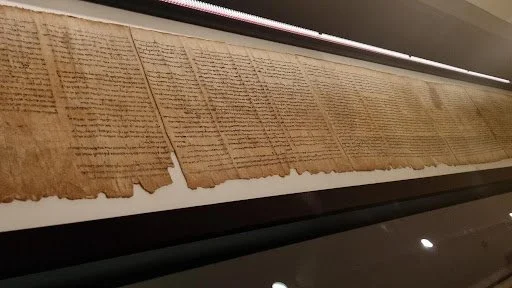
The Great Isaiah Scroll, one of the oldest surviving complete manuscripts of a biblical book.
The significance is enormous. The scroll preserves a form of Isaiah closely related to the later traditional Hebrew text, demonstrating substantial continuity across centuries of copying.
Does this mean every letter is identical? No. There are spelling differences, variations in wording, and some meaningful textual differences. But these are identifiable because the manuscript evidence survives.
The objection: If variations exist, doesn't that prove the Bible was changed?
It proves that scribes sometimes copied texts differently, not that the entire biblical message was replaced. The scrolls reveal both textual diversity and remarkable continuity. Rather than hiding those differences, scholars can study them and determine how the text developed.
The existence of ancient manuscripts provides a powerful safeguard against unsupported claims of wholesale rewriting. The comparison is available for anyone willing to investigate it.
2. Thousands of New Testament Manuscripts: A Problem for Anyone Trying to Rewrite Scripture
Consider the difficulty of secretly changing a document that exists in thousands of copies distributed among different communities.
That is precisely the problem facing the theory that one powerful institution rewrote the New Testament long after the apostles.
The New Testament survives in thousands of Greek manuscripts, alongside ancient translations into Latin, Syriac, Coptic, and other languages. These witnesses vary considerably in age and completeness, ranging from small fragments to entire collections of biblical books.
One of the most important is Codex Sinaiticus, produced in the fourth century AD. It contains the earliest surviving complete copy of the Greek New Testament.
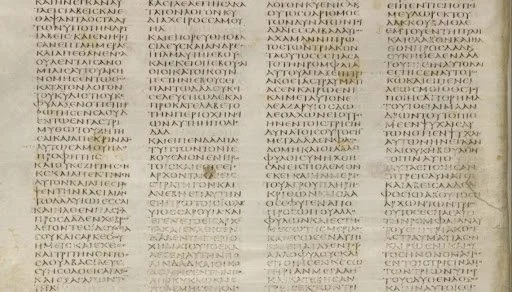
Codex Sinaiticus, a fourth-century biblical manuscript preserving the complete Greek New Testament.
Some manuscripts were copied in Egypt, others in regions of the eastern Mediterranean, and others in different parts of the Christian world. Their survival allows scholars to compare different lines of transmission rather than relying on a single manuscript controlled by one institution.
Imagine someone attempting to rewrite the Gospel of John after copies had already circulated among churches in different regions. Changing one collection would not automatically change the others. The remaining manuscripts could expose the alteration.
This does not mean that coordinated changes were physically impossible or that every manuscript agrees. It means the historical transmission of Scripture left a body of evidence that can be examined.
The more independent witnesses scholars possess, the better their opportunities to detect mistakes and reconstruct earlier forms of the text.
3. What About the Thousands of Errors Critics Mention?
One of the most common skeptical arguments is that New Testament manuscripts contain hundreds of thousands of textual variants.
That claim should not be ignored. There really are many differences among surviving manuscripts.
But the word variant does not automatically mean a major contradiction or deliberate alteration. It simply means that manuscript witnesses differ at a particular point.
Some differences involve spelling. Others concern word order, repeated phrases, accidentally omitted words, or scribal corrections. Because ancient Greek allowed greater flexibility in word order than English, different arrangements can sometimes preserve essentially the same meaning.
There are also significant variations that deserve serious examination.
For example, the longer ending of Mark (Mark 16:9–20) is absent from important early Greek manuscripts, including Codex Sinaiticus. The account of the woman caught in adultery (John 7:53–8:11) also has a complicated manuscript history and is absent from several early witnesses.
Modern translations frequently identify these passages in footnotes or brackets.
Some critics interpret this as proof that important passages were removed. But the surviving manuscript record also supports another explanation: certain passages were added to, or placed within, the textual tradition during transmission.
Either way, these textual differences are visible and can be investigated. Codex Sinaiticus itself contains numerous ancient corrections, which are available for scholarly analysis.
The strongest response to the objection is not to pretend variations do not exist. It is to show that textual criticism gives us methods for identifying them.
The central teachings of Christianity do not depend exclusively upon either of these disputed passages. The resurrection, the deity of Christ, salvation through faith, and the significance of Jesus' death are taught throughout numerous other New Testament texts.
Textual differences are real. The claim that they render the entire New Testament unknowable is a much greater assertion, and the manuscript evidence does not justify it.
4. Did Constantine and the Council of Nicaea Rewrite the Bible?
One particularly popular accusation is that Emperor Constantine gathered church leaders at the Council of Nicaea in AD 325 and decided which books would become Scripture.
This claim is historically incorrect.
The council principally addressed controversy over the relationship between the Father and the Son, particularly the teachings associated with Arius. There is no credible surviving evidence that its bishops voted on the contents of the biblical canon or created the New Testament.
Christians were already reading, quoting, and circulating the Gospels and apostolic letters long before Constantine was born.
In the late second century, Irenaeus defended the recognition of four Gospels. The Muratorian Fragment, commonly dated to the late second century, also witnesses to an early collection of New Testament writings, although its precise date is debated.
In AD 367, Athanasius listed exactly the 27 books recognized in the New Testament today. This is the earliest surviving document known to provide precisely that complete list, but it did not create the writings it named.
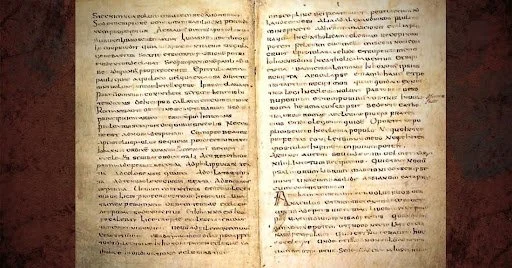
The Muratorian Fragment preserves an early list of Christian writings, helping historians trace the recognition of New Testament books.
There were genuine disagreements among early Christians regarding some books, including Revelation, Hebrews, and several shorter epistles. Those disagreements should be acknowledged. However, the four Gospels and many apostolic writings were already well established before fourth-century councils.
The historical record does not support the dramatic story that Constantine personally assembled a new Bible and imposed it upon Christianity.
The church debated and recognized its scriptural collection over time; it did not manufacture the Gospel accounts at Nicaea.
5. What About Books That Were Left Out?
Another accusation claims that numerous books were deliberately removed from the Bible because they revealed information church leaders wanted hidden.
Yet discovering that an ancient religious document exists does not establish that it was originally part of Scripture.
Early Christians distinguished between writings believed to carry apostolic authority, writings considered useful for instruction, and writings they regarded as unreliable or inconsistent with the faith received from the apostles.
Books such as the Gospel of Thomas and Gospel of Judas provide valuable evidence about some later Christian movements, but their existence does not demonstrate that they belonged to the original apostolic collection.
The Old Testament canon presents a different historical question, particularly regarding the books called the Apocrypha or Deuterocanon. Those disagreements involve Jewish textual traditions and differences among Christian communities, not simply a secret decision to erase Scripture.
The important distinction is between a book being known, a book being valued, and a book being recognized as Scripture. These are not interchangeable claims.
A writing's exclusion from the biblical canon does not, by itself, prove a conspiracy.
The Verdict: Has Scripture Survived the Test of Time?
If the Bible had been completely rewritten throughout history, the manuscript evidence should reveal the extent of those changes. Instead, we possess ancient witnesses that allow scholars to identify variations, compare textual traditions, and recover the wording of much of the biblical text with considerable confidence.
The Dead Sea Scrolls demonstrate substantial continuity in the transmission of Hebrew Scripture. Thousands of New Testament manuscripts provide evidence for examining centuries of Christian copying. Early Christian writings establish that the Gospels and apostolic letters existed long before the councils often accused of inventing them.
None of this requires claiming that every copyist was perfect or that every textual question has been resolved. The manuscripts themselves reveal otherwise. But the existence of identifiable differences is not evidence that the Bible's message has been lost.
The Christian understanding of Scripture's preservation does not require pretending that God prevented every copying mistake. It recognizes that, despite human fallibility, the biblical writings have survived through an extraordinary documentary tradition.
Jesus declared in Matthew 24:35 that heaven and earth would pass away, but His words would not pass away. The historical evidence cannot independently prove that divine promise, but it gives Christians substantial reason for confidence that the message transmitted through Scripture remains accessible today.
The Bible has not escaped examination. It has survived centuries of it.
And perhaps the most remarkable part is that the very manuscripts critics use to question Scripture are also the evidence that allows us to investigate its preservation.