Blind Faith: Does God Really Ask Us to Believe Without Evidence?
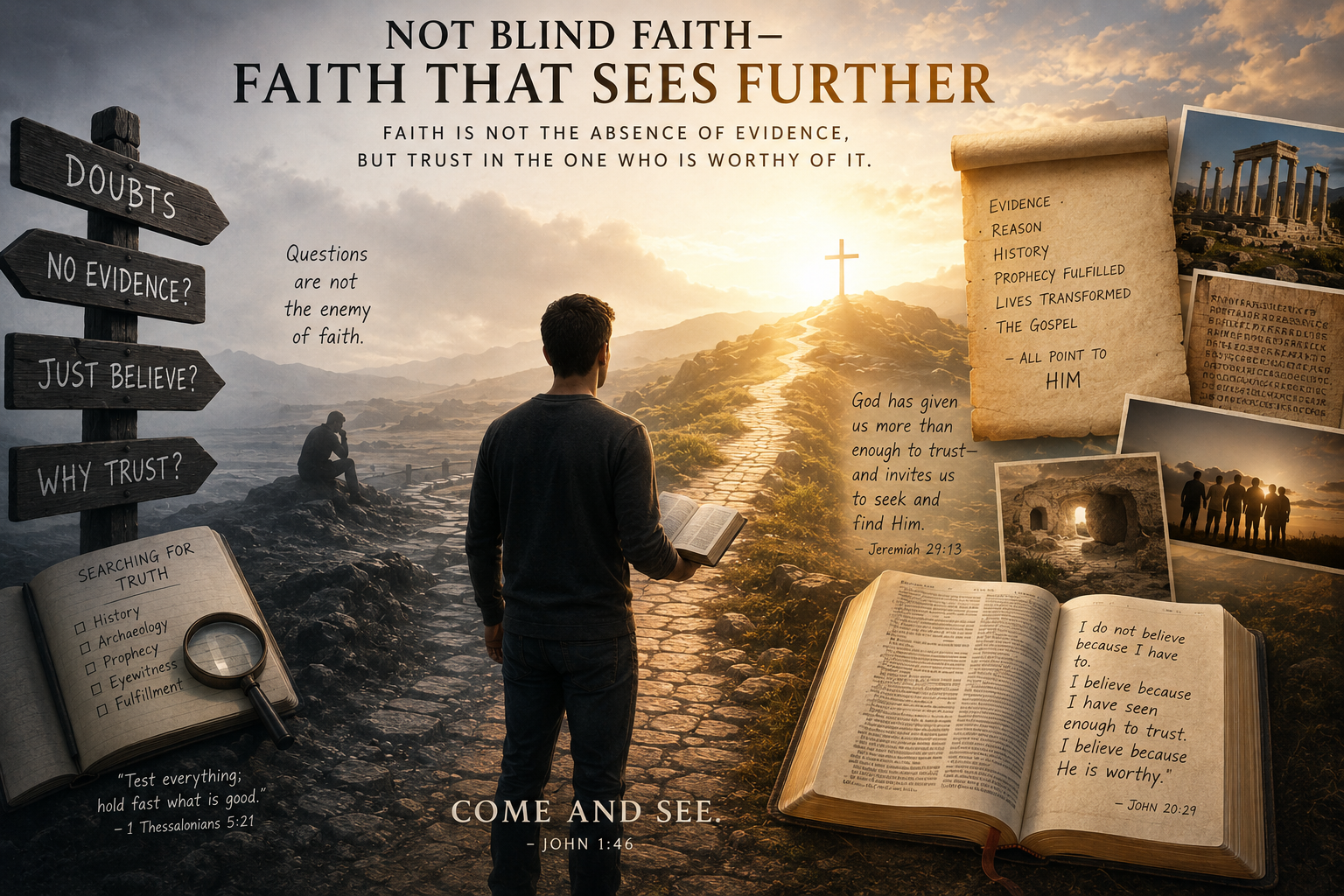
One of the most common criticisms of Christianity is that it requires blind faith. We've all heard the accusation: "You Christians just believe because you want to. You have faith without evidence."
What's surprising is that many Christians unintentionally reinforce that idea. Phrases like, "Just have faith," or, "You simply have to believe," are often offered with the best of intentions. They aren't meant to discourage honest questions. They simply recognize that there comes a point where we must trust God.
Before we go any further, let me make something clear. This article is not a criticism of Christians who have never studied apologetics or felt the need to examine every piece of evidence for their faith. Many sincere believers came to Christ through the testimony of family, by reading Scripture, or through God's work in their lives. There is nothing wrong with that.
My purpose is different.
I want to address the claim that Christianity itself requires blind faith. I don't believe the Bible teaches that. In fact, I believe Scripture presents the exact opposite. From Genesis to Revelation, God consistently provides reasons to trust Him. He demonstrates His power, fulfills His promises, authenticates His messengers, and then calls people to respond in faith.
Biblical faith is not believing without evidence. It is trusting the God who has shown Himself to be trustworthy.
God Invites People to Think
One of the first things that struck me while studying this subject was how often God invites people to reason rather than simply accept claims without question.
Through the prophet Isaiah, God says,
"Come now, let us reason together, says the LORD."
— Isaiah 1:18 (ESV)
That isn't the language of a God demanding blind acceptance. It is the invitation of a God who is willing to present His case.
The same pattern appears throughout Scripture. Paul tells believers,
"Test everything; hold fast what is good."
— 1 Thessalonians 5:21 (ESV)
He doesn't say, "Believe everything you're told." He encourages discernment.
Even Proverbs warns against reaching conclusions before examining the facts:
"The one who states his case first seems right, until the other comes and examines him."
— Proverbs 18:17 (ESV)
Truth has never been afraid of investigation.
If Christianity were built on blind faith, we would expect the Bible to discourage questions. Instead, it repeatedly encourages people to think, examine, remember, and test what they hear.
God Authenticated His Messengers
This pattern becomes even clearer when God calls His servants.
When Moses worried that Israel would not believe God had appeared to him, God didn't rebuke him for asking the question. Instead, He gave Moses miraculous signs—the staff becoming a serpent, the leprous hand being healed, and water from the Nile turning to blood.
Why?
Scripture tells us:
"That they may believe that the LORD... has appeared to you."
— Exodus 4:5 (ESV)
The miracles were not entertainment. They were evidence that God had truly sent His messenger.
Centuries later, Elijah faced the prophets of Baal on Mount Carmel. Israel had to decide who the true God was.
If blind faith were God's method, Elijah could simply have demanded belief.
Instead, he proposed a test.
The prophets of Baal called upon their god, but nothing happened. Elijah drenched his sacrifice with water and prayed. God answered by sending fire from heaven, consuming the sacrifice, the altar, and even the water surrounding it.
Only then did the people cry,
"The LORD, he is God; the LORD, he is God."
— 1 Kings 18:39 (ESV)
Again, the order matters.
God demonstrated His power first.
The people responded in faith afterward.
The same principle appears in fulfilled prophecy. Through Isaiah, God challenged the false gods to prove themselves by declaring the future:
"Tell us what is to come hereafter, that we may know that you are gods."
— Isaiah 41:23 (ESV)
Then God declared what made Him unique:
"I am God... declaring the end from the beginning."
— Isaiah 46:9–10 (ESV)
Only the true God can reveal history before it unfolds.
Centuries before Jesus was born, the Old Testament foretold details about His birth, ministry, suffering, death, and resurrection. God wasn't asking Israel to accept Jesus without evidence. He had been preparing the evidence for hundreds of years.
Jesus Followed the Same Pattern
When Jesus came, He didn't simply claim to be the Messiah.
He demonstrated it.
The blind received sight. The lame walked. Lepers were cleansed. Storms obeyed Him. The dead were raised.
John's Gospel repeatedly calls these miracles signs because they pointed beyond themselves to Jesus' identity.
Even Nicodemus recognized this when he said,
"No one can do these signs that you do unless God is with him."
— John 3:2 (ESV)
Perhaps the clearest statement comes from Jesus Himself:
"If I am not doing the works of my Father, then do not believe me; but if I do them... believe the works."
— John 10:37–38 (ESV)
Those words deserve careful attention.
Jesus never said, "Believe Me without evidence."
In fact, He said the opposite.
"If My works don't support My claims, don't believe Me."
He invited people to examine the evidence He provided.
His miracles didn't replace faith—they gave people a reason to place their faith in Him
Thomas and the Faith of Future Believers
Perhaps no passage is quoted more often in support of blind faith than Jesus' words to Thomas.
After Jesus' resurrection, Thomas refused to believe unless he personally saw the wounds in Christ's hands and side. Eight days later, Jesus appeared and invited Thomas to do exactly that. Overwhelmed, Thomas declared,
"My Lord and my God!"
— John 20:28 (ESV)
Jesus then replied,
"Have you believed because you have seen me? Blessed are those who have not seen and yet have believed."
— John 20:29 (ESV)
At first glance, it sounds as though Jesus is praising people who believe without evidence.
But is that really what He means?
Notice what Jesus doesn't say. He doesn't say, "Blessed are those who believe without any reason." Instead, He contrasts two groups of people: those who would see Him with their own eyes and those who would not.
Thomas became an eyewitness. Future believers—including us—would never have that opportunity.
So how were future generations supposed to believe?
John answers that question immediately. In fact, I think one of the most overlooked aspects of this passage is what comes next. The chapter doesn't end with Jesus' words to Thomas. John immediately explains why he wrote his Gospel:
"Now Jesus did many other signs in the presence of the disciples, which are not written in this book; but these are written so that you may believe that Jesus is the Christ, the Son of God, and that by believing you may have life in his name."
— John 20:30–31 (ESV)
Those verses are crucial.
John doesn't say, "Believe without seeing because evidence doesn't matter."
He says, "These signs were written so that you may believe."
Thomas believed because he saw.
We believe because God preserved the testimony of those who did.
John's Gospel isn't an invitation to blind faith. It is the preservation of eyewitness evidence for those who would come after the apostles.
That doesn't mean everyone will accept that testimony. Even in Jesus' own day, many rejected Him despite witnessing His miracles firsthand. Evidence does not force belief. But it does show that Christianity was never presented as a religion detached from history. It is rooted in real events that the biblical writers claimed actually happened.
The Apostles Continued the Same Pattern
The apostles understood this perfectly.
When Peter preached on the Day of Pentecost, he didn't begin by saying, "Just believe."
Instead, he reminded the crowd of what they had already witnessed:
"Jesus of Nazareth, a man attested to you by God with mighty works and wonders and signs that God did through him in your midst, as you yourselves know..."
— Acts 2:22 (ESV)
Peter appealed to public evidence before calling people to faith.
Luke did the same. He opened his Gospel by explaining that he had carefully investigated everything from the beginning so that his readers could have confidence in what they had been taught (Luke 1:1–4).
Peter later wrote,
"We did not follow cleverly devised myths... but we were eyewitnesses of his majesty."
— 2 Peter 1:16 (ESV)
John emphasized the same truth:
"That which we have heard, which we have seen with our eyes... and touched with our hands... we proclaim also to you."
— 1 John 1:1, 3 (ESV)
Again and again, the apostles pointed people back to history—to what they had seen, heard, and experienced.
Even the Bereans were praised because they didn't simply accept Paul's teaching. They searched the Scriptures daily to see whether his message was true (Acts 17:11).
The Bible never portrays honest investigation as the enemy of faith.
It commends it.
What About Hebrews 11?
Some will immediately think of Hebrews 11:1:
"Now faith is the assurance of things hoped for, the conviction of things not seen."
— Hebrews 11:1 (ESV)
Many assume this defines faith as believing without evidence.
But that's not what the verse says.
It speaks of things not seen, not things without evidence.
There is a difference.
Every day we believe things we have never personally witnessed because reliable testimony and historical evidence convince us they happened. None of us saw Julius Caesar cross the Rubicon or Abraham Lincoln deliver the Gettysburg Address, yet we accept those events because of the evidence preserved for us.
Christianity is no different.
None of us stood outside Lazarus' tomb or looked into the empty tomb on Easter morning. But God did not leave us without testimony. He preserved the eyewitness accounts of those who were there. He preserved fulfilled prophecy that pointed to Christ centuries in advance. He preserved the testimony of men who suffered persecution and death rather than deny what they claimed to have seen.
Hebrews 11 itself illustrates this principle.
Noah trusted God's warning about a flood he had never seen because he trusted the God who spoke.
Abraham believed God's promises because he had already learned God's faithfulness.
The heroes of faith were not commended for believing without reason. They were commended for trusting the God who had proven Himself faithful.
Faith was their response to God's character.
Faith Is the Step, Not the Evidence
Perhaps the simplest illustration is a bridge spanning a deep canyon.
Imagine you examine the bridge carefully. You learn who designed it. You inspect its construction. You watch thousands of people cross it safely. Everything points to the same conclusion: the bridge is trustworthy.
Eventually, however, evidence can take you only so far.
You still have to step onto the bridge.
The evidence doesn't cross it for you.
Trust does.
Biblical faith works the same way.
God has not asked us to leap into darkness. He has given us fulfilled prophecy, historical testimony, the miracles of Christ, the witness of the apostles, and above all, the person of Jesus Himself. Those things provide a solid foundation for belief.
But eventually each of us must decide whether we will trust the One to whom that evidence points.
Conclusion
The phrase blind faith is often used as though it accurately describes Christianity.
After examining the Scriptures, I don't believe it does.
From beginning to end, the Bible presents a God who reveals Himself. He authenticates His messengers through signs, distinguishes Himself through fulfilled prophecy, confirms His Son through miracles, and preserves eyewitness testimony for generations who would never see those events for themselves.
None of this means every question has been answered or that evidence alone guarantees belief. Scripture itself records people who witnessed miracles and still hardened their hearts. Faith is more than acknowledging facts; it is choosing to trust.
But neither does God ask us to believe without any reason.
The biblical pattern is remarkably consistent: God reveals Himself, and then He calls people to trust Him.
That is why I don't believe Christianity calls for blind faith.
It calls for informed faith—a faith grounded in God's self-revelation, His faithfulness throughout history, and the testimony He has preserved for us.
We were not standing beside Moses at the Red Sea, Elijah on Mount Carmel, or Thomas in the upper room. But God knew we wouldn't be. That is why He gave us the testimony of those who were.
Faith, then, is not closing our eyes and believing anyway.
It is looking honestly at what God has revealed and placing our trust in the One who has proven Himself faithful.