Turning the Other Cheek: Was Jesus Teaching Passive Christianity?
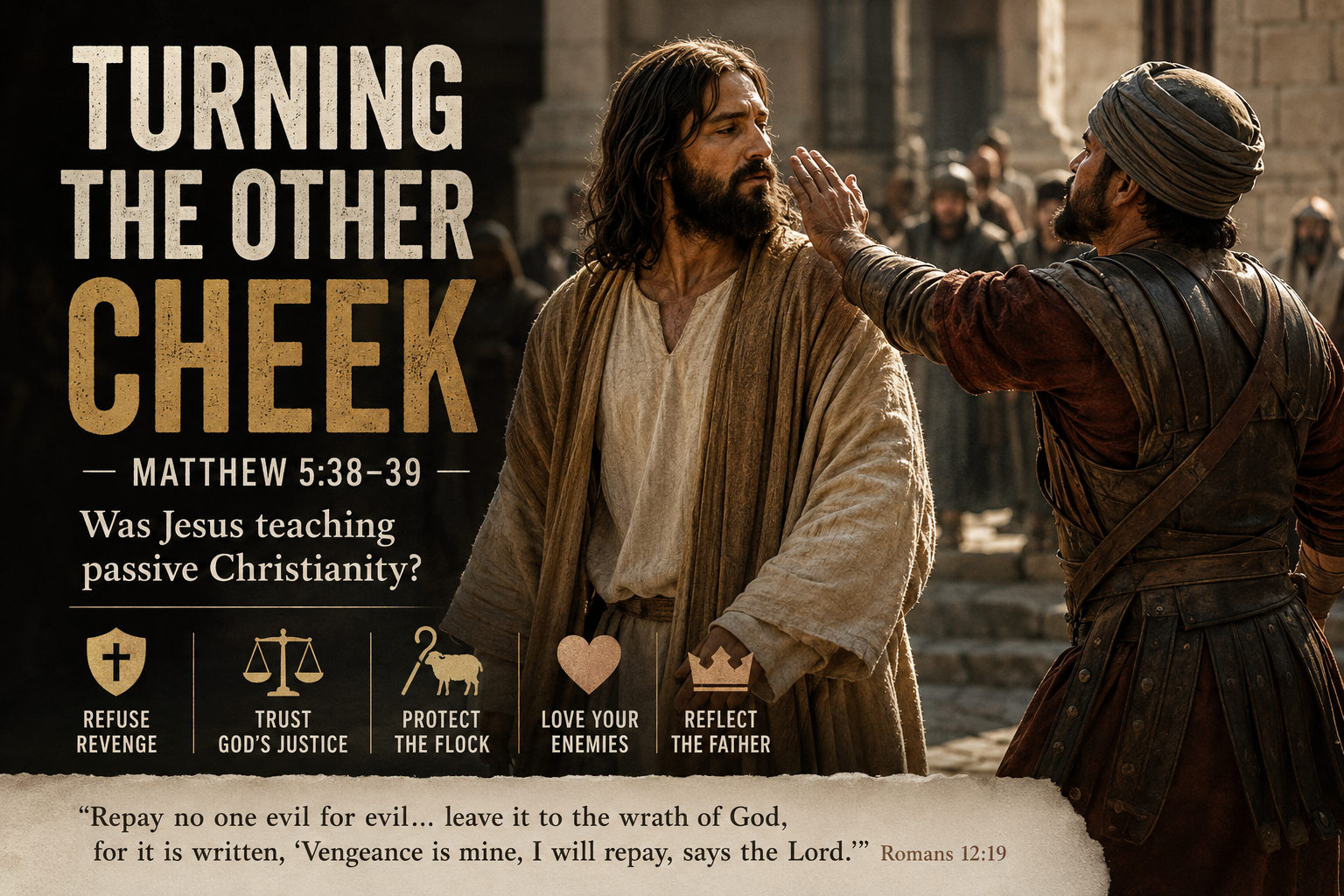
Matthew 5:38–39 is one of the most quoted—and one of the most debated—teachings of Jesus.
"You have heard that it was said, 'An eye for an eye and a tooth for a tooth.' But I say to you, Do not resist the one who is evil. But if anyone slaps you on the right cheek, turn to him the other also." (Matthew 5:38–39, ESV)
For many Christians, these verses settle the discussion. They conclude that Jesus was teaching complete passivity—that a believer should never defend himself, never confront evil, and never resist those who seek to do harm.
Others reject that conclusion entirely, arguing that Christians have every right to respond however they see fit.
I believe both positions miss the point.
Before going any further, I want to be clear about what I am not arguing. I am not suggesting that Christians should be quarrelsome, vindictive, or eager for conflict. Nor am I argueing that every use of force is justified. My purpose is much narrower. I simply want to examine whether Jesus' command to turn the other cheek requires believers to remain passive in every circumstance. The best way to answer that question is to let the rest of Scripture explain Jesus' words.
The problem is that Matthew 5:38–39 is almost always read in isolation. Jesus did not stop speaking at verse 39. His teaching continues through verse 48, and when the entire section is read together, a very different picture begins to emerge. Rather than giving a list of disconnected commands, Jesus is describing what it looks like to live as a citizen of God's kingdom in a world that rejects God's ways. Every example points toward the same principle: believers are not to respond to evil the way the world responds to evil.
The real question, then, is not whether Christians should ignore evil. The question is whether Jesus was condemning all resistance or only personal revenge. The best way to answer that question is to let Scripture interpret Scripture.
Jesus begins by quoting the familiar phrase, "An eye for an eye and a tooth for a tooth." Many people assume this law encouraged retaliation, but that is not why God gave it. In the Old Testament, this principle served as a guide for judges. It ensured that punishment fit the crime and prevented justice from becoming excessive. Instead of encouraging revenge, it actually restrained it.
By the first century, however, many had taken this judicial principle and turned it into a personal one. Rather than trusting God's system of justice, people used it to justify settling personal scores. Jesus challenges that attitude. He says, "Do not resist the one who is evil." Yet before we conclude that Jesus forbids all resistance to evil, we should ask an important question. Did Jesus Himself live that way?
If our interpretation of Matthew 5 requires Jesus to remain completely passive in every situation, then His own life should consistently reflect that interpretation. If it does not, then perhaps we have misunderstood His words.
The first example comes during Jesus' trial. John records that after Jesus answered the high priest, one of the officers standing nearby struck Him across the face. "Then one of the officers standing by struck Jesus with his hand, saying, 'Is that how you answer the high priest?' Jesus answered him, 'If what I said is wrong, bear witness about the wrong; but if what I said is right, why do you strike me?'" (John 18:22–23, ESV)
This account is remarkable. Jesus does not retaliate. He does not strike the officer in return. He does not threaten him. But neither does He silently accept the injustice as though nothing happened. Instead, He calmly confronts the wrongdoing by asking a simple question: "If I spoke wrongly, prove it. But if I spoke truthfully, why do you strike Me?" This response perfectly reflects the principal Jesus taught in Matthew 5. He refuses revenge without surrendering truth. He exposes injustice without becoming unjust Himself.
That distinction is crucial. Turning the other cheek does not mean pretending evil is good. It means refusing to answer evil with evil. The same pattern appears throughout Jesus' ministry.
When He entered the temple and found merchants corrupting His Father's house, He did not ignore it. John tells us that Jesus made a whip of cords and drove out those who had turned the temple into a marketplace (John 2:13–17). His actions were decisive, but they were not motivated by personal offense. They were motivated by zeal for God's holiness.
Likewise, Jesus repeatedly confronted the religious leaders. In John 8, He declared, "You are of your father the devil" (John 8:44, ESV). Those words were severe, but they were not spoken from wounded pride or a desire for revenge. Jesus was exposing spiritual truth. His purpose was conviction, not retaliation.
Even Jesus' instructions to His disciples before His arrest deserve consideration.
In Luke 22:36, He tells them, "Let the one who has no sword sell his cloak and buy one" (ESV). Faithful Christians have understood this passage in different ways, and I do not intend to settle every question surrounding it here. What it does show, however, is that the discussion is more nuanced than simply saying Christians must never resist evil under any circumstance.
What becomes increasingly clear is that Jesus consistently distinguishes between righteous action and personal vengeance. The apostle Peter recognized this distinction. Writing about Christ's suffering, Peter points believers back to Jesus as their example.
"For to this you have been called, because Christ also suffered for you, leaving you an example, so that you might follow in his steps... When he was reviled, he did not revile in return; when he suffered, he did not threaten, but continued entrusting himself to him who judges justly." (1 Peter 2:21–23, ESV)
Notice what Peter says—and what he does not say. He does not say Jesus never spoke. He does not say Jesus never confronted sin. He does not say Jesus remained passive in every circumstance. Instead, Peter says Jesus refused to retaliate. He refused to threaten. Rather than taking vengeance into His own hands, He entrusted Himself to the righteous Judge. That language should sound familiar because Paul teaches the very same principle.
In Romans 12 he writes,
"Repay no one evil for evil, but give thought to do what is honorable in the sight of all... Beloved, never avenge yourselves, but leave it to the wrath of God, for it is written, 'Vengeance is mine, I will repay, says the Lord.'" (Romans 12:17, 19, ESV) This is the missing piece that often goes unnoticed in discussions about turning the other cheek. Paul does not say evil should be ignored. He does not say justice no longer matters. He says vengeance belongs to God. There is a profound difference between justice and revenge. Justice seeks what is right. Revenge seeks personal satisfaction. Justice is impartial. Revenge is personal. Justice trusts God. Revenge attempts to replace Him.
Does refusing personal vengeance mean Christians should become passive while others are harmed? Scripture answers that question as well. The same Bible that tells believers not to avenge themselves also commands shepherds to protect God's flock from wolves (Acts 20:28–31; 1 Peter 5:1–4). Solomon instructs God's people, "Rescue those who are being taken away to death; hold back those who are stumbling to the slaughter" (Proverbs 24:11–12, ESV). The issue, therefore, is not whether Christians should act. The issue is why they act. Scripture consistently condemns actions motivated by personal revenge while commending actions motivated by love, justice, truth, and the protection of others.
This same distinction runs throughout Scripture. Individuals are forbidden from taking personal vengeance. Civil government is given the responsibility to punish evildoers (Romans 13:1–4). The church is entrusted with exercising discipline within the body of Christ. Above all, God reserves final judgment for Himself. When individuals assume the role of ultimate judge, they step into an authority God never gave them. That is exactly what Jesus is correcting in Matthew 5. He is not commanding believers to become passive observers while evil flourishes. He is teaching them to surrender the deeply human desire to get even.
The world answers insult with insult. Jesus answers insult with truth. The world answers hatred with hatred. Jesus answers hatred with love. The world demands revenge. Jesus entrusts judgment to His Father. When the entire witness of Scripture is considered, the meaning of Matthew 5 becomes much clearer. Turning the other cheek is not a command to abandon courage, ignore injustice, or refuse to confront evil. Jesus Himself did none of those things. Instead, it is a call to reject personal vengeance while continuing to walk in righteousness.
Christians are called to defend truth without hatred, confront sin without revenge, seek justice without bitterness, and love even those who oppose them. That is far more difficult than either passive surrender or angry retaliation. It requires a heart that has been transformed by the grace of God.
Perhaps that is why Jesus ends this section with a call to reflect the character of the Father. The goal is not simply to avoid fighting. The goal is to become people who respond to a fallen world the way our heavenly Father responds—with perfect righteousness, perfect justice, and perfect love. Turning the other cheek is not weakness. It is strength that has surrendered revenge to God.
For the Christian, justice has not been abandoned. It has simply been placed into the hands of the only Judge who can administer it perfectly.