For thousands of years, the Bible has recorded the names of kings, nations, cities, battles, and civilizations. Many of these kingdoms eventually disappeared, their cities were buried, and their written records were lost. Yet their stories remained preserved in the pages of Scripture. As archaeologists began excavating the ancient world, something remarkable happened: they started uncovering physical evidence of people and events described in the Bible.
Archaeology does not depend on religious belief. Ancient inscriptions cannot be persuaded to support Christianity, and a buried monument does not change its message depending on who discovers it. These artifacts were often created by people who did not worship the God of Israel, making their testimony particularly valuable.
While no single discovery establishes the truth of every biblical claim, archaeology has provided independent confirmation of numerous details once known primarily from Scripture. Four remarkable examples demonstrate why the Bible deserves to be treated as a serious historical record.
1. King David: The King Whose Name Was Found in Stone
For generations, King David was one of the most recognizable figures in biblical history. The books of Samuel and Kings describe his rise to power, his kingdom, and the dynasty that continued after his death. Yet outside the Bible, direct evidence identifying David was scarce. Some scholars questioned whether he existed as a historical king at all, suggesting he might have been a legendary figure developed through Israel's traditions.
That discussion changed dramatically in 1993, when archaeologists excavating Tel Dan in northern Israel discovered a fragment of a ninth-century BC stone monument. Additional fragments were recovered in 1994. The inscription, written in Aramaic, commemorated military victories attributed by scholars to an Aramean king, likely Hazael.
Most importantly, it contained the expression widely translated as "House of David."
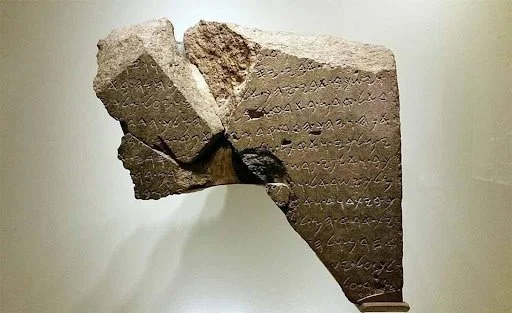
The Tel Dan Stele, dating to the ninth century BC, contains the earliest widely accepted extrabiblical reference to the House of David.
The significance is substantial. This wasn't an Israelite biblical manuscript praising David. It was an inscription produced by a neighboring kingdom, referring to a royal dynasty associated with his name.
A skeptic might argue that identifying a dynasty named after David does not prove every event recorded about his life. That is true, but it does not erase the discovery's significance. The question of whether a Davidic royal house was recognized in the ancient Near East is precisely what this inscription helps answer.
It is no longer reasonable to claim that there is no ancient evidence outside Scripture for the Davidic dynasty. The Tel Dan Stele provides independent historical support for the biblical tradition of the House of David, consistent with passages such as 2 Samuel 7:12–16.
2. Sennacherib: When Israel's Enemy Recorded the Same War
In 2 Kings 18–19, the Bible describes an invasion of Judah by Sennacherib, king of Assyria, during the reign of King Hezekiah. According to Scripture, the Assyrians captured fortified cities throughout Judah and threatened Jerusalem. Hezekiah sought God's deliverance, and Jerusalem ultimately survived.
What makes this account extraordinary is that the Assyrian king recorded his own version of the campaign.
The Taylor Prism, a six-sided clay monument dated to 691 BC and housed in the British Museum, describes Sennacherib's military campaigns. It specifically identifies Hezekiah, king of Judah, and describes the Assyrian invasion of 701 BC. Sennacherib boasts that he captured 46 fortified cities of Judah and confined Hezekiah within Jerusalem like a bird in a cage.
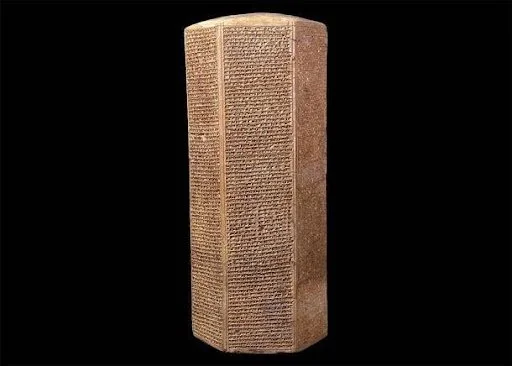
The Taylor Prism records Sennacherib's campaign against Judah and names King Hezekiah.
Consider the remarkable agreement. Both records identify the same opposing kings, the same kingdom, the same invasion, and Jerusalem as the center of Hezekiah's resistance.
But there is another interesting detail. Although Sennacherib celebrates his victories in Judah, he does not claim to have conquered Jerusalem. The Bible likewise records the city's survival.
Critics correctly point out that the Assyrian inscription does not confirm the supernatural destruction of Sennacherib's forces described in 2 Kings 19:35. Nor does the absence of a conquest claim independently establish why the Assyrians withdrew. Yet the historical agreement remains important: the biblical account accurately situates a major military confrontation documented by Judah's enemy.
The two sources differ in their explanations and emphasis, but they are not describing imaginary kingdoms or invented rulers. They are competing accounts of a real historical conflict.
3. Pontius Pilate: The Roman Governor Who Condemned Jesus
The Gospels identify Pontius Pilate as the Roman official who authorized Jesus' crucifixion. Matthew 27, Mark 15, Luke 23, and John 18–19 all place him at the center of the trial.
For centuries, knowledge of Pilate came primarily from ancient written accounts, including the New Testament and Jewish historians. Then, in 1961, Italian archaeologists excavating the Roman theater at Caesarea Maritima discovered a limestone inscription bearing his name.
The inscription identifies Pontius Pilate as prefect of Judaea, an official title associated with Roman provincial administration.
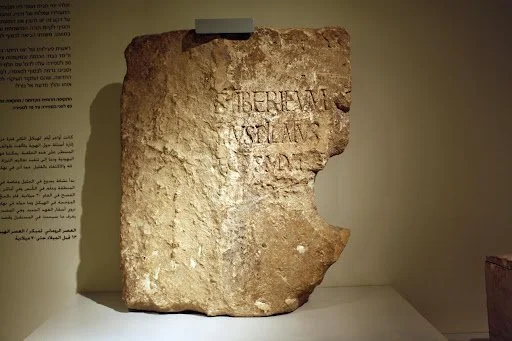
The Pilate Stone, discovered in 1961 at Caesarea, identifies Pontius Pilate as prefect of Judaea.
This discovery independently confirms not only Pilate's existence but also his official position in the Roman government. It places an individual central to the Gospel narratives within the actual administration of first-century Judaea.
Some argue that proving Pilate existed does not prove that Jesus performed miracles or rose from the dead. That objection addresses claims the stone was never expected to establish. Its importance lies in corroborating the Gospels' historical setting and one of their principal figures.
The Gospel writers described a Roman official who held authority in Judaea during Jesus' lifetime. Archaeology has confirmed that such a man held precisely that office.
4. The Pool of Bethesda: A Detail Too Specific to Ignore
One of the most fascinating archaeological discoveries concerns a seemingly minor detail in the Gospel of John.
In John 5:2, the writer describes a pool in Jerusalem near the Sheep Gate, called Bethesda in many translations, surrounded by five covered walkways or porticoes. Jesus later heals a man who had been disabled for 38 years.
The description initially seems unusual. Most rectangular pools would be expected to have four surrounding walkways, not five. Some scholars interpreted the number symbolically rather than historically.
Archaeological investigations near the Church of Saint Anne in Jerusalem, however, revealed a complex containing two adjoining pools separated by a central partition. This arrangement explains how the structure could have five porticoes: four around the outer perimeter and one across the middle.
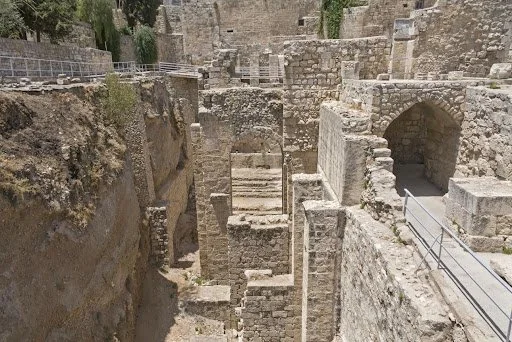
The archaeological remains of the Pool of Bethesda complex in Jerusalem.
Why is this important? John did not simply claim that Jesus visited a pool in Jerusalem. He included a distinctive architectural detail that corresponds to a real ancient site.
Could the writer have possessed accurate geographical knowledge without witnessing the miracle himself? Certainly. But that possibility does not weaken the archaeological confirmation of the location. It demonstrates that the Gospel preserves authentic knowledge of Jerusalem's ancient landscape.
This is particularly significant because Jerusalem suffered extensive destruction under the Romans in AD 70. Such details contribute to the case that John's account draws upon knowledge of the city as it existed in the first century.
The excavations do not independently prove the healing miracle, but they do corroborate the physical setting in which John places it.
The Verdict: What Does the Evidence Show?
These discoveries come from different centuries, different civilizations, and different archaeological sites. They were not produced by one group attempting to establish the accuracy of the Bible. They include the records of foreign kings, Roman officials, and the physical remains of ancient Jerusalem.
Taken together, they demonstrate something important: the biblical writers repeatedly described historical people, governments, conflicts, and locations that can be independently investigated and corroborated.
An important distinction remains between confirming historical details and establishing supernatural events. Archaeology alone cannot prove every biblical miracle. However, these discoveries decisively challenge the sweeping argument that the Bible's historical narratives are merely fictional stories without meaningful external support.
For Christians, this evidence strengthens confidence that Scripture is rooted in real history. It also provides a compelling starting point for examining its larger claims.
The Bible does not describe a faith disconnected from the physical world. It places God's dealings with humanity among identifiable kings, nations, cities, and events.
And when archaeologists uncover that ancient world, they repeatedly find evidence consistent with the historical setting preserved in Scripture.