Did the Church Replace Israel?
One of the major disagreements among Christians concerns the relationship between Israel and the Church. When Israel rejected Jesus as the Messiah, did God reject Israel and transfer His promises to the Church? Has the Church become the new Israel, or does God still have a future purpose for the Jewish people?
This question matters for more than understanding prophecy. It touches something much deeper: the faithfulness of God. There is no question that Israel rejected Jesus. There is also no question that Jews and Gentiles who believe in Christ are united together in one body. But neither of those truths automatically means that God canceled the promises He made to Israel.
In fact, the Bible never actually says that the Church replaced Israel. Instead, when Paul directly asks whether God has rejected His people, his answer could hardly be stronger: “Has God rejected his people? By no means!” (Romans 11:1, ESV). So what does Scripture actually teach?
Jews, Gentiles, and the Church
Paul makes an interesting distinction in 1 Corinthians when he writes, “Give no offense to Jews or to Greeks or to the church of God” (1 Corinthians 10:32, ESV). Paul mentions three groups: Jews, Gentiles, and the Church.
This verse alone does not settle the entire debate, but it shows that Paul was capable of distinguishing between these groups. The Church contains believing Jews and Gentiles united in Christ, but Paul can still speak about Israel as a distinct people. That becomes especially important in Romans 9–11. If the Church had simply replaced Israel, these three chapters become difficult to explain. Paul spends an enormous amount of time discussing Israel's past, present, and future after the Church had already been established.
Has God Forgotten Israel?
Romans 9 begins with Paul's heartbreak over Israel's unbelief. He writes, “I have great sorrow and unceasing anguish in my heart” (Romans 9:2, ESV). He then describes his fellow Israelites as those “to whom belong the adoption, the glory, the covenants, the giving of the law, the worship, and the promises” (Romans 9:4, ESV).
Romans 10 moves to Israel's present condition. Paul says, “Brothers, my heart's desire and prayer to God for them is that they may be saved” (Romans 10:1, ESV). Israel possesses tremendous privileges, but that does not mean individual Jewish people are automatically saved. They need Jesus just as Gentiles do. There are not two different ways of salvation. Jew and Gentile alike must come to God through Jesus Christ.
But then Romans 11 asks the question at the center of this entire debate: “I ask, then, has God rejected his people? By no means!” (Romans 11:1, ESV). If Paul wanted to teach that God was finished with Israel and had replaced Israel with the Church, this would have been the perfect opportunity. Instead, Paul says the opposite.
The Olive Tree
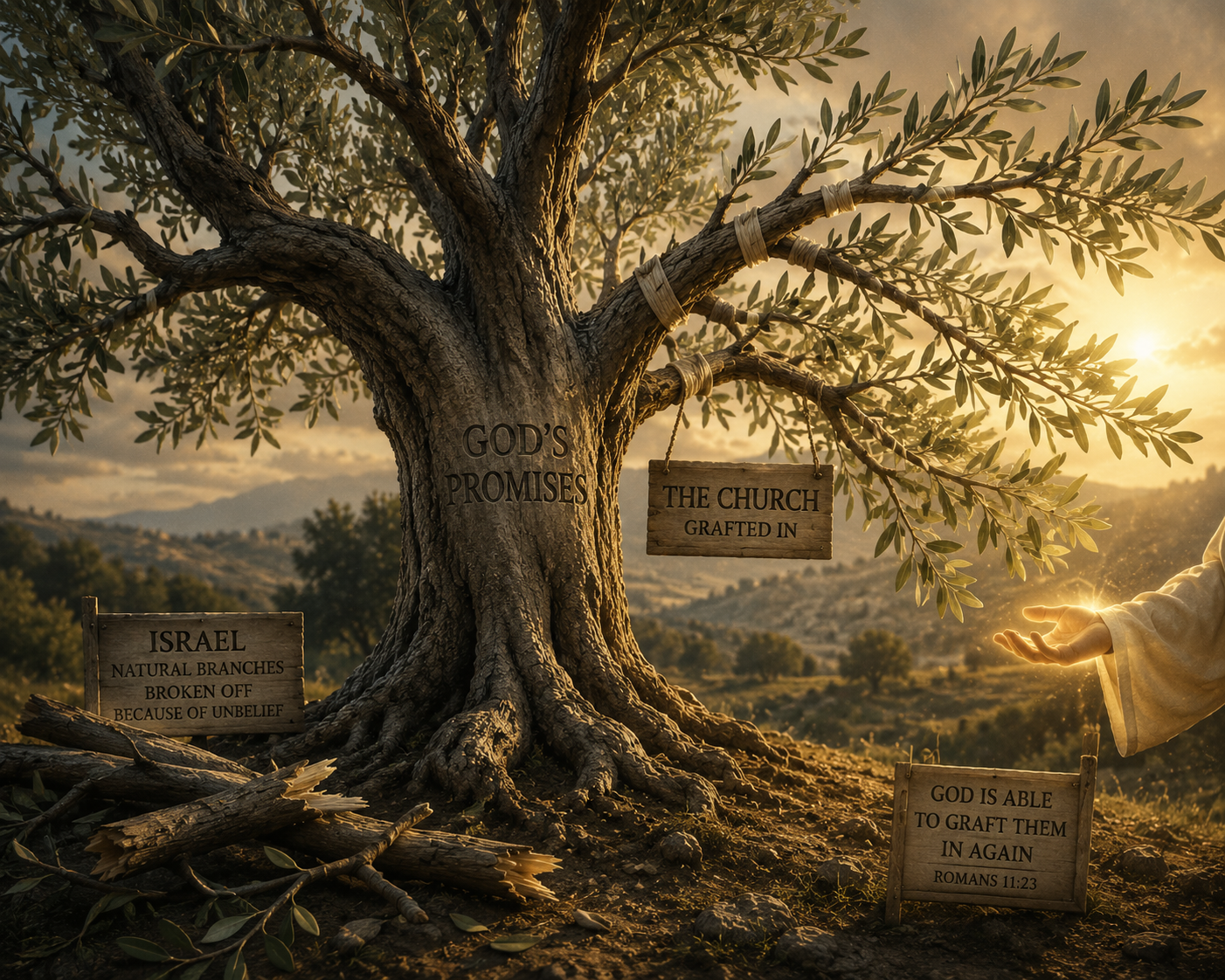
Paul then gives the illustration of an olive tree. Some of the natural branches were broken off because of unbelief, and believing Gentiles were grafted into the tree. But notice what Paul does not say. He does not say that God destroyed Israel's tree and planted a completely different tree called the Church. Instead, Gentiles are described as wild branches grafted into something that already existed.
Paul then gives Gentile believers a remarkable warning: “do not be arrogant toward the branches” (Romans 11:18, ESV). Why warn Gentile Christians against boasting over Israel if Israel has simply ceased to have a place in God's purposes? Paul continues, “And even they, if they do not continue in their unbelief, will be grafted in, for God has the power to graft them in again” (Romans 11:23, ESV). God is not finished with the natural branches.
Israel's Blindness Is Not Permanent
This becomes even clearer a few verses later when Paul writes that “a partial hardening has come upon Israel, until the fullness of the Gentiles has come in” (Romans 11:25, ESV). Two words are especially important here: partial and until. Israel's blindness is not described as total, and it is not described as permanent.
Jesus had already spoken about this blindness. As He approached Jerusalem shortly before His crucifixion, Jesus wept over the city and said, “Would that you, even you, had known on this day the things that make for peace! But now they are hidden from your eyes” (Luke 19:42, ESV). Jesus then predicted Jerusalem's destruction because “you did not know the time of your visitation” (Luke 19:44, ESV). Israel had failed to recognize its Messiah. Judgment followed, but rejection was not necessarily the end of Israel's story.
Earlier Jesus had lamented, “O Jerusalem, Jerusalem, the city that kills the prophets and stones those who are sent to it!” Yet He concludes with an extraordinary statement: “For I tell you, you will not see me again, until you say, ‘Blessed is he who comes in the name of the Lord’” (Matthew 23:37, 39, ESV).
There is that word again: until. Jesus' statement appears to look beyond Jerusalem's rejection toward a future recognition of Him.
They Rejected Their Deliverer the First Time
There is also an interesting pattern running through Israel's history, and Stephen highlights it in Acts 7. Consider Joseph. Joseph's brothers rejected him. They sold him into slavery, and Joseph eventually became powerful in Egypt while his brothers remained unaware of his identity. Then Stephen specifically says, “And on the second visit Joseph made himself known to his brothers” (Acts 7:13, ESV). The one his brothers had rejected became the one God used to save them.
Then Stephen tells the story of Moses. When Moses initially attempted to intervene for his fellow Israelites, one responded, “Who made you a ruler and a judge over us?” (Acts 7:27, ESV). Moses was rejected. Yet Stephen later says, “This man God sent as both ruler and redeemer” (Acts 7:35, ESV). The deliverer Israel rejected became the deliverer God sent back to them.
Stephen then brings the pattern directly into his own generation when he asks, “Which of the prophets did your fathers not persecute?” (Acts 7:52, ESV). And finally they had rejected Jesus.
The pattern is striking. Joseph was rejected and later recognized. Moses was rejected and later received as deliverer. Jesus was rejected by His own people. Does Scripture indicate that Israel will someday recognize the One they rejected? It appears that it does.
“They Will Look on Me, on Him Whom They Have Pierced”
Hundreds of years before Jesus' crucifixion, Zechariah recorded an extraordinary prophecy: “when they look on me, on him whom they have pierced, they shall mourn for him…” (Zechariah 12:10, ESV). The pierced One is eventually recognized.
This fits remarkably well with Jesus' statement to Jerusalem: “you will not see me again, until you say, ‘Blessed is he who comes in the name of the Lord.’” It also fits Paul's statement that “a partial hardening has come upon Israel, until the fullness of the Gentiles has come in.” Paul then immediately says, “And in this way all Israel will be saved…” (Romans 11:26, ESV).
Whatever details Christians may disagree about concerning the fulfillment of these prophecies, it is difficult to read Romans 11 as Paul announcing that God's relationship with Israel is permanently over. His conclusion points in precisely the opposite direction: “For the gifts and the calling of God are irrevocable” (Romans 11:29, ESV).
What About the Church?
None of this diminishes the Church. The New Testament clearly teaches that believing Jews and Gentiles are united in Christ. Paul writes, “There is neither Jew nor Greek…for you are all one in Christ Jesus” (Galatians 3:28, ESV). Ephesians 2 similarly describes Christ making believing Jews and Gentiles into “one new man.”
Gentiles are not second-class believers, and Jewish believers do not have a different means of salvation. There is one body and one Savior. But unity in salvation does not require us to conclude that every promise God made to national Israel has been transferred to the Church. Being included in God's blessings is not the same thing as replacing the people to whom God previously made promises. That distinction is important.
What About the Verses Used to Support Replacement Theology?
There are passages that deserve serious consideration. Galatians 3 says believers in Christ are Abraham's offspring. Galatians 6:16 refers to “the Israel of God.” Romans 2 speaks about being a Jew inwardly. Peter applies language once spoken of Israel—“a chosen race, a royal priesthood, a holy nation”—to believers in 1 Peter 2:9.
These passages demonstrate something wonderful: Gentile believers have been brought into blessings that once appeared impossibly distant from them. But none of these passages actually says, “The Church has replaced Israel.” Nor do they say that God's promises to national Israel have been canceled.
In fact, interpreting them that way creates tension with Paul's explicit statement in Romans 11: “Has God rejected his people? By no means!” We should allow the clear statement to help interpret the more disputed ones.
What About the Kingdom?
Another fascinating passage appears immediately before Jesus' ascension. The disciples ask, “Lord, will you at this time restore the kingdom to Israel?” (Acts 1:6, ESV). Notice Jesus' response. He does not say, There will be no restoration of Israel. You are Israel now. Instead He says, “It is not for you to know times or seasons that the Father has fixed by his own authority” (Acts 1:7, ESV). Jesus addresses the timing rather than explicitly denying the expectation of restoration.
Later, Peter tells Jewish hearers, “Repent therefore, and turn back,” and speaks about “times of refreshing” and “the time for restoring all the things about which God spoke by the mouth of his holy prophets long ago” (Acts 3:19–21, ESV). The language of restoration did not disappear when the Church was born.
The Promises of God
Ultimately, this question goes back much farther than Romans. God made promises to Abraham, Isaac, and Jacob. Israel's history is filled with failure, rebellion, idolatry, judgment, exile, and unbelief. Yet God's faithfulness repeatedly survives Israel's unfaithfulness.
Jeremiah records one of the strongest statements: “If this fixed order departs from before me, declares the LORD, then shall the offspring of Israel cease from being a nation before me forever” (Jeremiah 31:36, ESV). God compares Israel's continued existence before Him with the established order of creation. Interestingly, this appears immediately after God's promise of the New Covenant with “the house of Israel and the house of Judah.”
Israel failed. Israel was judged. Israel rejected its Messiah. But Scripture never says that Israel's failure caused God to become unfaithful to His promises.
Did the Church Replace Israel?
The Church has received extraordinary blessings through Jesus Christ. Jews and Gentiles who believe in Him have been reconciled to God and to one another. There is no spiritual superiority based upon ethnicity, and there is no salvation apart from Christ. But that is different from saying the Church replaced Israel.
Paul's illustration may actually warn us against exactly that attitude. Gentile believers are grafted into the olive tree, and Paul tells them, “do not be arrogant toward the branches” (Romans 11:18, ESV). The natural branches were broken off because of unbelief, but Paul immediately reminds us that God is able to graft them in again. The warning is significant. Gentile believers were never told to look at Israel's unbelief and conclude that they had permanently taken Israel's place. Instead, Paul warned them against arrogance toward the very branches that had been temporarily broken off.
I also believe there may be a warning against this same attitude in Revelation. Jesus speaks of “those who say that they are Jews and are not” (Revelation 2:9; see also Revelation 3:9, ESV). I want to be clear that this is my interpretation of the passage, rather than something the text explicitly identifies as replacement theology. However, I believe it is at least possible that these words apply to those who would claim for themselves an identity that God has not given them—particularly the claim that the Church has replaced Israel and has therefore become Israel. What makes the wording especially interesting is that Jesus is speaking to churches, yet He still refers separately to people who “say that they are Jews and are not.” If the Church had simply replaced Israel and become Israel, this distinction would be difficult to explain. At the very least, the passage should make us cautious about claiming that God has transferred Israel's identity to someone else.
Israel's blindness is partial, and Israel's blindness lasts until something happens. Paul says that “a partial hardening has come upon Israel, until the fullness of the Gentiles has come in” (Romans 11:25, ESV). Jesus likewise said Jerusalem would not see Him again “until you say, ‘Blessed is he who comes in the name of the Lord’” (Matthew 23:39, ESV). Zechariah foresaw a day when they would “look on me, on him whom they have pierced” and mourn for Him (Zechariah 12:10, ESV). These passages point toward a future recognition rather than a permanent rejection. Paul therefore asks the question directly: “Has God rejected his people?” His answer leaves little room for uncertainty: “By no means!” (Romans 11:1, ESV).
Perhaps the greatest reason this subject matters is not merely because of Israel. It matters because of what it tells us about God. If God could make promises, allow centuries to pass, and then permanently abandon those promises because the people receiving them were unfaithful, what confidence could any of us have in His promises?
Israel's history certainly demonstrates human unfaithfulness. But Israel's future may demonstrate something far greater: the unchanging faithfulness of God.
“For the gifts and the calling of God are irrevocable.”
— Romans 11:29, ESV