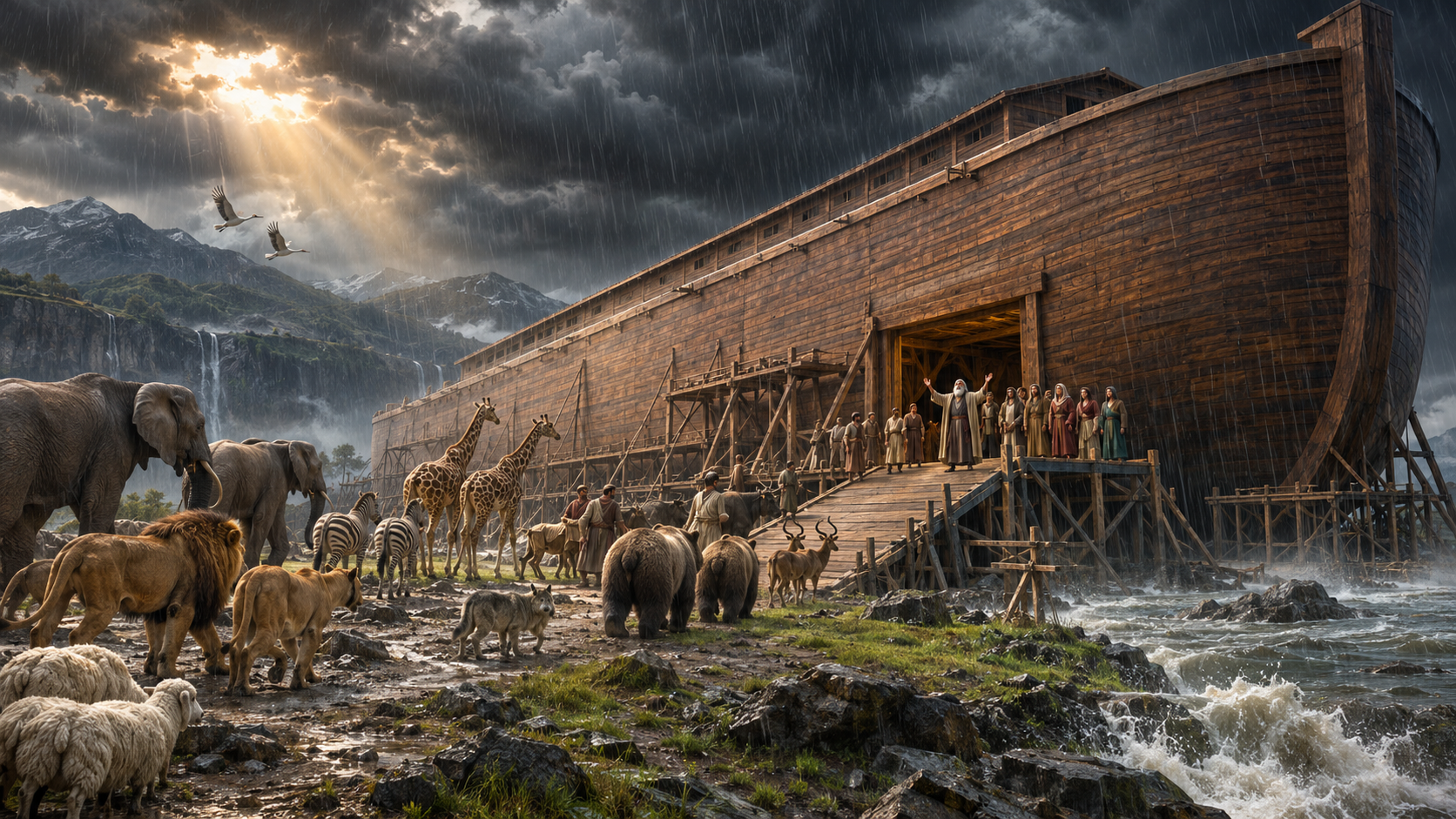
What if one of the most extraordinary events recorded in the Bible also left its mark on the earth and in the memories of civilizations around the world? Genesis describes a catastrophic flood that destroyed the world of Noah's time, preserving only eight people and representatives of the animal kingdom aboard an enormous wooden vessel. For centuries, skeptics have questioned whether such an event could have happened. Yet geological discoveries, the practical dimensions of Noah's Ark, and ancient flood accounts raise questions worth investigating.
The existence of catastrophic floods is not disputed. Neither is the fact that civilizations across the ancient world preserved remarkable accounts of overwhelming floods. The larger question is whether these discoveries could be connected to the event described in Genesis.
Genesis 7:11 describes the beginning of the Flood with two extraordinary events: the fountains of the great deep burst open, and the windows of heaven were opened. According to the account, water came from both below and above, producing a catastrophe far greater than an ordinary rainstorm.
Rain fell for forty days and nights, but the Flood lasted considerably longer. Genesis 7:24 states that the waters prevailed for 150 days. Eventually, the fountains of the deep and the windows of heaven were closed, the waters began to recede, and the Ark came to rest upon the mountains of Ararat.
Genesis describes the waters covering even the high mountains under heaven. The narrative is therefore presenting something more extensive than a localized river flood. It describes a judgment that transformed the world known to Noah.
If an event of this magnitude occurred, we might reasonably ask whether it left physical evidence and whether humanity preserved memories of it.
Fossils: Evidence of Rapid Burial
One of the most interesting geological observations concerns how fossils form. When an animal dies and remains exposed, scavengers, bacteria, weather, and other natural processes begin breaking down its remains. Under ordinary surface conditions, complete preservation is unlikely.
For fossilization to occur, certain conditions must protect the organism from destruction. Rapid burial beneath sediment is one of the most effective ways this happens.
The United States National Park Service explicitly recognizes that rapid burial protects remains from decomposition, weathering, and scavengers. Fossils of delicate organisms, articulated skeletons, and exceptional soft-tissue impressions can provide evidence of unusually favorable preservation conditions.
This is particularly interesting when considering the immense quantities of sediment that rapidly moving water can transport. Catastrophic floods can bury organisms, redistribute sediment, and dramatically transform landscapes. Such processes are observable in the modern world.
However, the rapid burial of an organism and the complete mineralization of its remains are not necessarily simultaneous events. Although fossil preservation can begin quickly, different fossils form through different processes over varying periods.
What does this mean for Noah's Flood? It establishes that catastrophic sedimentation is a genuine mechanism capable of producing fossil deposits. It does not establish that every fossil on Earth formed during the same catastrophe. Nevertheless, rapid burial is an important geological process that deserves examination when evaluating the biblical account.
Water Hidden Deep Within the Earth
In 2014, researchers published a remarkable discovery in the scientific journal Nature. Scientists examining a diamond from Brazil identified ringwoodite, a mineral that forms under the extraordinary pressures found deep within Earth's mantle.
The ringwoodite contained water within its crystal structure.
Researchers concluded that parts of the mantle transition zone, approximately 410 to 660 kilometers beneath Earth's surface, can store significant quantities of water. Depending on the minerals' distribution and water content, this region has the potential to contain an enormous reservoir of water.
Consider the language of Genesis 7:11, written thousands of years before scientists discovered these water-bearing minerals. The passage describes the fountains of the great deep breaking open.
The discovery is fascinating because it confirms that substantial water can exist deep within Earth's interior. However, this is not a hidden liquid ocean waiting beneath the surface. The water is incorporated into minerals, and no evidence currently establishes that it erupted during Noah's Flood.
Still, the comparison raises an intriguing question about the Earth's interior and the biblical description of waters originating from the deep. The discovery itself is scientifically established, even if its proposed connection to Genesis remains a subject of interpretation.
Noah's Ark: Was It Large Enough?
One of the most common objections to Noah's Flood concerns the Ark itself. How could Noah possibly have accommodated the animals, stored sufficient provisions, and kept them alive for such an extended period?
Genesis 6:14–16 provides surprisingly specific construction instructions. God told Noah to build the Ark from gopher wood, divide it into compartments, cover it with pitch inside and outside, and construct three levels. The vessel measured 300 cubits long, 50 cubits wide, and 30 cubits high.
Using an ordinary 18-inch cubit, that gives us a vessel approximately 450 feet long, 75 feet wide, and 45 feet high, with roughly 101,250 square feet of gross deck area.
The Ark was not designed to travel quickly or navigate toward a destination. Its primary function was to preserve life while floating through the catastrophe.
The pitch served an important purpose by waterproofing the wooden structure. The compartments would have allowed animals and supplies to be separated, while the three levels provided considerable usable space. Genesis 6:16 also describes an upper opening, although its precise construction is uncertain. This feature may have helped with light and ventilation.
Another important detail concerns the animals themselves.
Genesis describes animals being preserved according to their kinds. It does not say Noah brought every modern breed or every named species aboard. Creationist researchers have proposed that many modern species descended from a smaller number of ancestral kinds.
Researchers associated with the Ark Encounter estimate approximately 1,398 land-animal and flying-creature kinds, represented by about 6,744 individual animals under their model, including extinct groups. These figures depend on a particular interpretation of biological kinds and are not established counts from Noah's lifetime.
Nevertheless, they permit a meaningful capacity calculation. The Ark's dimensions offer substantial space, although housing the animals would also require food storage, drinking water, ventilation, waste management, and suitable enclosures.
These logistical challenges should not be dismissed. But neither should someone claim the Ark was too small without first considering its actual dimensions and the number and sizes of animals it would have needed to carry.
Why Did Ancient Civilizations Remember a Great Flood?
Perhaps the most historically intriguing evidence comes from civilizations that preserved their own accounts of devastating floods.
Some of these traditions contain similarities to Genesis that extend far beyond the simple occurrence of rising water.
Mesopotamia: A Man, a Boat, Animals, and Birds
The Epic of Gilgamesh contains one of the most remarkable ancient flood accounts. Utnapishtim receives a warning of approaching destruction, constructs an enormous vessel, and brings his family and animals aboard. A terrible flood follows, destroying humanity outside the vessel.
After the waters subside, the boat comes to rest upon a mountain. Utnapishtim releases a dove, a swallow, and a raven to determine whether the land has become habitable again. He eventually offers a sacrifice.
Now compare Genesis 6–9. Noah receives a divine warning, builds an Ark, preserves his family and animals, survives the Flood, sends out birds, and offers a sacrifice after leaving the vessel.
The similarities are exceptionally specific.
These are not stories invented by modern Christian apologists. Ancient Mesopotamian flood accounts survive on genuine cuneiform tablets. The famous flood tablet from the Epic of Gilgamesh is preserved in the British Museum.
Scholars recognize literary connections among Mesopotamian flood traditions and Genesis, although they disagree about how those relationships developed. The surviving texts establish the antiquity of the traditions, but not which account most faithfully represents any original event.
India: Manu and the Vessel of Survival
In the ancient Indian Śatapatha Brāhmaṇa, Manu receives a warning from a supernatural fish that a devastating flood is approaching.
Following the warning, Manu prepares a ship. When the waters rise, he enters the vessel, which is guided to a northern mountain. He remains there until the waters recede, after which human life continues through him.
The similarities include a warning, preparation of a vessel, overwhelming waters, survival, a mountain, and humanity's continuation afterward.
Although the religious details differ considerably from Genesis, the common narrative structure is worth examining.
Greece: Deucalion and Pyrrha
Ancient Greek tradition tells of Deucalion and his wife Pyrrha surviving a devastating flood sent by Zeus.
According to the account preserved in the Bibliotheca, Deucalion receives advance warning through Prometheus, prepares a large chest with provisions, and escapes the destruction. After nine days and nights, the vessel reaches Mount Parnassus, where Deucalion eventually makes a sacrifice.
Once again, we encounter a warned survivor, a prepared vessel, catastrophic flooding, a mountain landing, sacrifice, and the continuation of humanity.
China: The Great Flood
Chinese civilization also preserves ancient accounts of an overwhelming flood, particularly the traditions surrounding Yao and Yu the Great.
These accounts differ from Noah's narrative because they focus primarily on bringing floodwaters under control rather than preserving animals aboard a vessel.
Nevertheless, their importance becomes clearer when we consider that researchers have investigated geological evidence of an enormous ancient flood in China as a possible historical background for the traditions. The proposed identification remains debated.
This demonstrates that ancient flood narratives are not necessarily treated as meaningless legends; some can be investigated through archaeology and geology.
An Ancient Record Dividing History Before and After the Flood
Another significant document is the Sumerian King List.
One surviving version, preserved at the Ashmolean Museum in Oxford, dates to approximately 1800 BC. It records kings and dynasties, distinguishing rulers before a great flood from those who came afterward.
The list famously states that a flood swept over the land before kingship was established again.
The document combines legendary and historical material and includes extremely long reigns attributed to early rulers. Nevertheless, the division between the world before the flood and the world afterward is unmistakable.
Genesis also presents a major division in human history surrounding the Flood. Its genealogies record extraordinarily long lifespans before the catastrophe, followed by a progressive decline in the generations afterward.
These similarities do not establish that both works describe the same event, but they demonstrate the importance of a great flood in ancient accounts of humanity's past.
Could All These Accounts Preserve a Common Memory?
The worldwide distribution of flood traditions raises a legitimate historical question.
Why do several civilizations describe more than catastrophic flooding? Why do some remember warnings, prepared vessels, chosen survivors, mountains, sacrifices, and the restoration of humanity?
There are competing explanations. Ancient populations could have preserved memories of a shared catastrophe that developed differently over generations. Some stories could have spread through cultural contact, while others may have arisen independently from devastating regional floods.
The existence of these alternatives does not erase the documented similarities. It means that we must distinguish between demonstrating that ancient peoples remembered great floods and establishing that every tradition traces back to one worldwide event.
Nevertheless, these accounts deserve to be taken seriously as part of humanity's historical and cultural inheritance.
The World After the Flood
The aftermath of Genesis is nearly as intriguing as the catastrophe itself.
Noah eventually departed the Ark with his family. God established His covenant with Noah, and Genesis 9 records the rainbow as the sign associated with that promise.
The genealogies that follow also record a striking decline in human lifespans. Noah lived 950 years, Shem 600, Arpachshad 438, Abraham 175, and Joseph 110.
Some have suggested that environmental changes, genetic factors, or population bottlenecks following the Flood could have contributed to this decline. However, no particular biological mechanism has been established as the explanation for the biblical ages.
The pattern is clearly present in the scriptural record. Its physical cause remains uncertain.
Conclusion: A Story That Deserves Investigation
Noah's Flood is not an account that should be dismissed without examination. Scripture describes a detailed catastrophe, while geology confirms the ability of floods and rapid sedimentation to produce dramatic changes and preserve organisms. The Ark's specified dimensions allow serious questions of animal accommodation and engineering to be investigated. Scientific discoveries reveal substantial water-bearing minerals deep within the Earth. And ancient civilizations preserved remarkable traditions of overwhelming floods, sometimes sharing highly specific details with Genesis.
None of these observations, individually or together, currently provides conclusive scientific proof that a single flood covered the entire planet in Noah's time. The geological consensus remains that Earth's fossil record and rock formations cannot be explained by one recent worldwide flood.
Yet the evidence does establish something worth considering: catastrophic floods are genuine historical and geological events, and the biblical narrative belongs to a much wider ancient conversation about overwhelming waters, survival, and humanity's beginnings.
For those who believe Genesis records a real divine judgment, the similarities provide meaningful subjects for investigation. For those who remain skeptical, the historical texts and geological discoveries offer concrete material to examine rather than dismiss.
The question is not whether ancient people told stories about great floods. They unquestionably did.
The deeper question is whether some of those traditions preserve memories of a catastrophe that humanity has never entirely forgotten.