Where Did We All Come From?
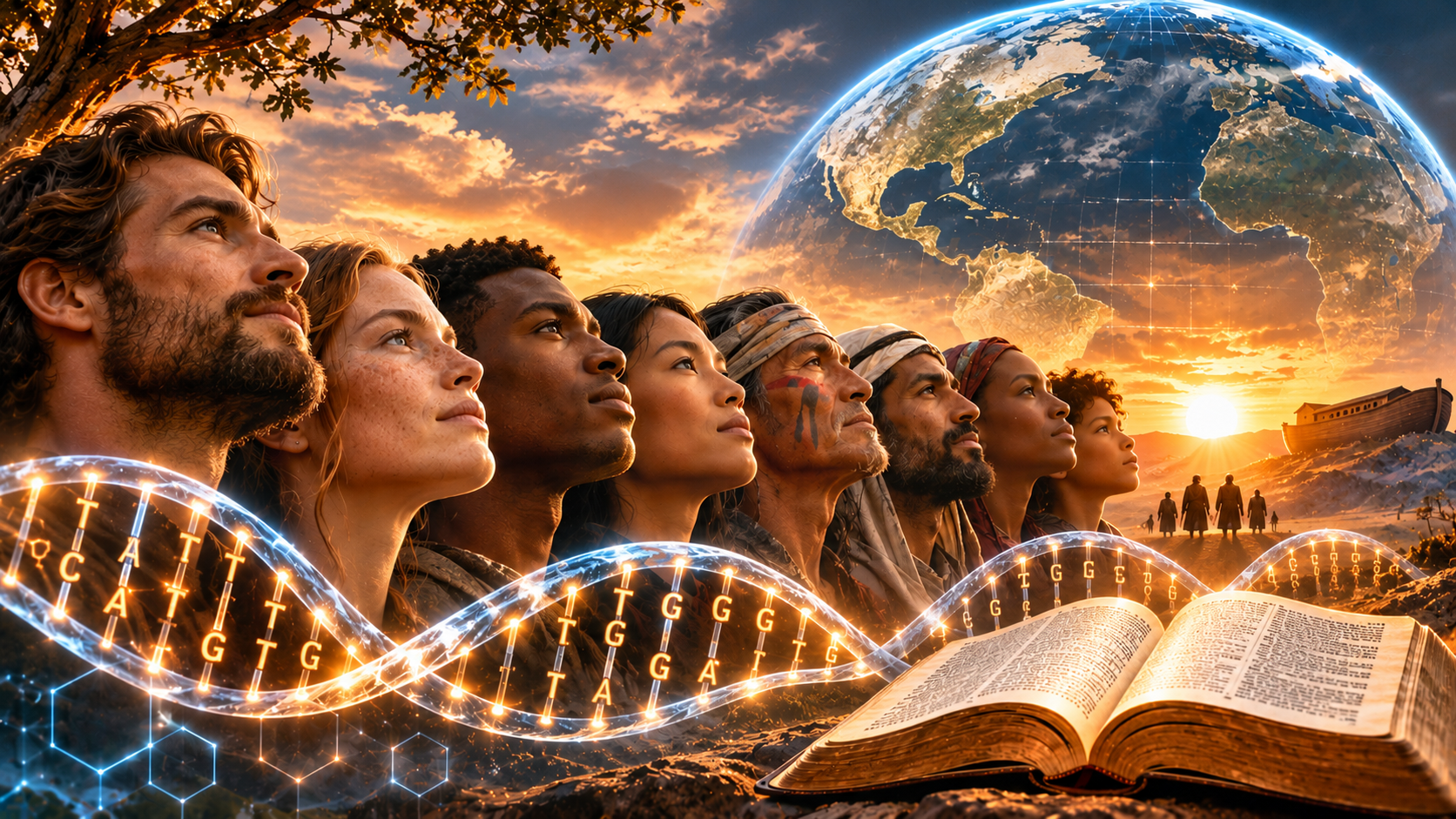
Someone recently asked, “If we all came from just one man and one woman, how did we get so many different appearances, ethnicities, and cultures?”
It is a reasonable question, especially when we look at the incredible diversity among people around the world. We see different skin tones, facial features, hair textures, and physical characteristics. We also see distinct languages, traditions, and cultures. How could all of this have developed if humanity began with one man and one woman?
To understand the question, we need to look at both the scientific discoveries surrounding human ancestry and the biblical account of creation. Modern evolutionary theory explains human origins through a long process of biological development and common ancestry. However, the question of where life ultimately came from, how the complexity of living organisms originated, and why the universe exists at all reaches beyond simply describing biological changes. Scripture gives us an answer to the origin of humanity: God created mankind.
Genesis 1:27 tells us, “So God created man in his own image, in the image of God he created him; male and female he created them” (ESV). Genesis 2 then gives us a more detailed account of the creation of Adam and Eve. According to Scripture, humanity did not begin with separate groups of people created independently across the earth. We began with one man and one woman.
This understanding is also reflected in Acts 17:26, which states that God “made from one man every nation of mankind to live on all the face of the earth.” The Bible establishes a common human beginning. We are not separate kinds of people with separate origins; we are one human family.
Interestingly, research into human genetics has uncovered evidence of shared ancestry through two particular genetic lines. One involves mitochondrial DNA, which is passed from mothers to their children. Because this genetic material follows the maternal line, researchers can trace it backward through generations to a common maternal ancestor. This woman is commonly referred to as Mitochondrial Eve.
The research that brought mitochondrial DNA ancestry into wider scientific discussion was published in 1987 by Rebecca Cann, Mark Stoneking, and Allan Wilson. Their study examined mitochondrial DNA from 147 people and identified a shared maternal lineage among living humans. This means that the maternal lines of people living today trace back to a common ancestor.
There is a corresponding finding involving the Y chromosome, commonly called Y-chromosomal Adam. The Y chromosome is passed from father to son, allowing researchers to trace an unbroken paternal line backward through generations. Together, mitochondrial DNA and Y-chromosome research reveal two distinct ancestral lines: one shared maternal ancestor, and one shared paternal ancestor among living humans.
These genetic findings are significant because they demonstrate how inherited material can be traced through generations to common ancestors. From the biblical perspective, humanity's beginning is traced to Adam and Eve. From the findings of Rebecca Cann and a few others, human beings are traced back to one woman and one man.
The biblical account continues beyond Adam and Eve to Noah and his family. Genesis 7:13 identifies Noah, his wife, his three sons, and their wives as those who entered the ark. That means eight people survived the Flood. Afterward, God commanded them in Genesis 9:1, “Be fruitful and multiply and fill the earth” (ESV). Humanity would once again grow from a small family.
It is not difficult to understand how a family could grow into a much larger population over several generations. As children grew up, married, and had children of their own, the number of descendants would increase. With multiple generations reproducing, a population could grow into the thousands. Scripture does not give us an exact population count for every generation after Noah, but it does provide the family structure and command for humanity to multiply.
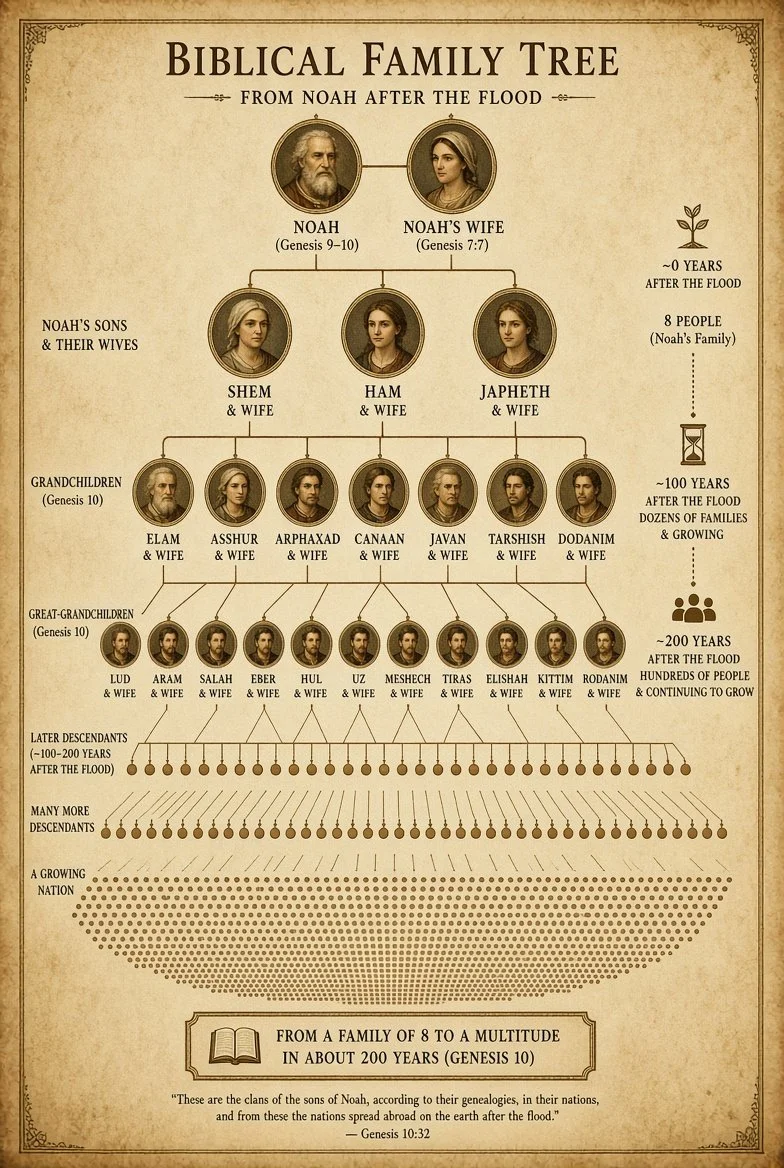
Genesis 10 gives us another important part of this account. Often called the Table of Nations, this chapter records the descendants of Noah's three sons: Shem, Ham, and Japheth. Their families spread out and became the beginnings of different nations and people groups. This helps us understand how humanity could develop distinct populations, languages, and cultures as families spread across the earth.
But what about our physical differences? How did people develop different skin tones, hair textures, facial features, and other inherited characteristics? The answer involves the way genetic traits are passed from parents to children. Each child receives a combination of genetic material from both parents. This creates variation within families and populations, even when they share the same ancestors.
Over many generations, inherited differences can become more common in certain populations. Mutations introduce new genetic variations, while genetic drift and the founder effect can change how common particular traits become in smaller or isolated groups. Natural selection can also influence which traits become more common in particular environments. For example, skin pigmentation is partly related to exposure to ultraviolet radiation. Populations living in regions with different levels of sunlight developed different patterns of pigmentation over many generations.
Geography also played an important role. As families migrated and settled in different parts of the world, some populations became separated from others. Over time, differences in environment, inherited traits, and population history contributed to the physical diversity we see today. Distinct cultures and languages also developed as communities formed, separated, and established their own traditions.
None of this requires humanity to have originated from separate beginnings. Genetic variation, reproduction, migration, and generations of inheritance help explain how one human family can become remarkably diverse. The differences among us are real, but they do not make us different kinds of human beings. We share the same basic human nature and belong to the same human family.
The Invitation to Seek
There is nothing wrong with asking questions. In fact, we should be willing to examine what we believe, investigate the evidence, and pursue answers rather than accepting something simply because we have been told it is true. Christianity does not require us to abandon our ability to think, question, or investigate. God gave us minds to use, and the world He created is worth examining. Proverbs 25:2 reminds us, “It is the glory of God to conceal things, but the glory of kings is to search things out” (ESV). We should never be afraid of honest questions or the pursuit of knowledge.
However, our search for answers should not stop with scientific research or human reasoning. If we want to know the One who created us, we should be willing to seek Him. Ask God to reveal Himself. Ask Him for wisdom, understanding, and discernment as you examine the questions that matter. Jeremiah 29:13 says, “You will seek me and find me, when you seek me with all your heart” (ESV). Seeking God is not an invitation to stop thinking; it is an invitation to bring our questions before Him and pursue truth with an open and sincere heart.
You do not have to be afraid of questions about creation, human origins, or the existence of God. Investigate the evidence. Read Scripture for yourself. Examine the claims being made, and consider whether the explanations you are given actually answer the questions being asked. Do not mistake unanswered questions for proof that there are no answers, and do not assume that something is true simply because it is widely accepted. Be willing to keep searching.
Ultimately, our origins are not meaningless or accidental. We were created by God, share one human beginning, and belong to one family. The diversity we see across humanity does not contradict that beginning. It is a reflection of the many generations that have come from it. And as we continue asking questions and seeking answers, may our pursuit of truth lead us not only to understand the world around us, but also to know the Creator who made it.